Local SEO for Metal Building Dealers

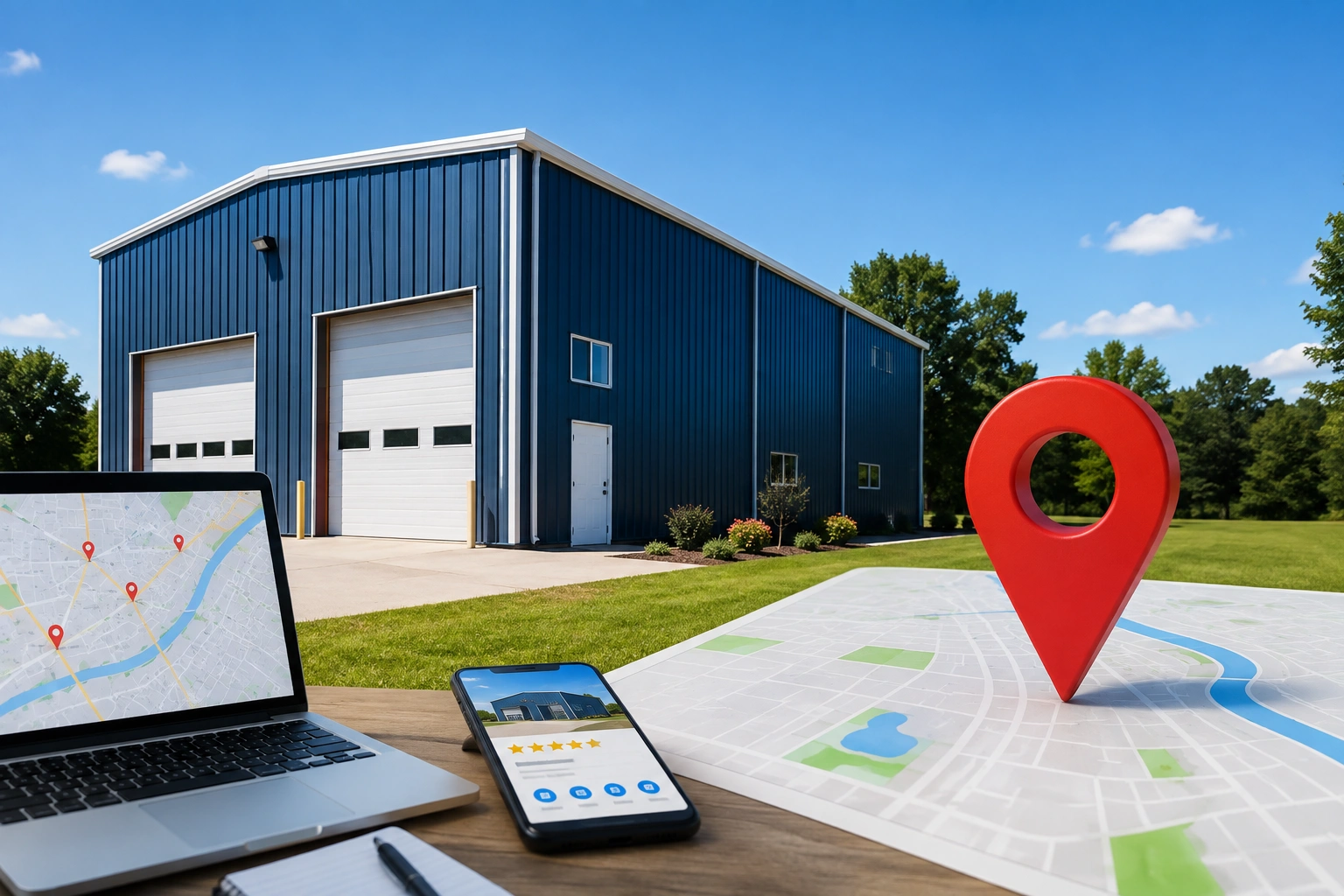
A customer in Dallas types “metal garage near me” into Google. Three dealers show up on the map with reviews, photos, and phone numbers one tap away. A fourth dealer, who may build better structures at a fairer price, is nowhere on that first screen. That customer calls one of the three. They never find out the fourth dealer existed.
This happens every day across the metal building industry. Dealers who sell garages, barns, carports, RV covers, and commercial steel buildings often serve a defined area, sometimes a single county, sometimes a dozen states. But if their Google Business Profile is thin or their website has no real information for the cities they serve, local buyers simply never see them. The building might be excellent. The pricing might be fair. None of that matters if the phone never rings.
Local SEO is how a metal building dealer becomes visible for the searches that actually lead to quote requests. It’s not a side project. For a business that depends on local and regional buyers, it’s one of the main paths to new customers.
This article walks through what it means, how it works for this specific industry, and what an owner can do this month to start showing up where buyers are already looking.
What Local SEO Means for Metal Building Dealers
People use “SEO” as one big word, but for a metal building dealer it splits into a few different things.
Traditional SEO is about ranking a website in the general organic results for a search term, no matter where the searcher is. Local SEO is narrower. It’s about ranking for searches tied to a place, and about showing up in the map results (often called the “local pack”) that Google places above or alongside the regular listings.
Google Maps visibility and Google Business Profile visibility are closely related but not identical. Your Google Business Profile is the free listing that controls your name, address, phone number, hours, photos, and reviews. It feeds both the map pack and the knowledge panel that appears when someone searches your business name directly. Organic local visibility is different again; it’s your website ranking for a search like “metal barn dealer in Georgia” because the page itself is relevant, fast, and trusted.
Here’s a simple example. Someone in Fort Worth searches “steel building supplier near me.” Google shows a map with three pinned businesses at the top, then a list of organic website results below. A dealer might rank well in one of those two areas and be missing from the other. Getting both right is the actual goal of local SEO for this industry.
Why Local SEO Matters for Metal Building Dealers
Metal building buyers are not casual browsers. Someone searching “metal garage dealer in Houston” already knows what they want and is close to picking a supplier. That’s a high-intent search, and high-intent local searches convert at a different rate than generic informational traffic.
There are a few concrete reasons this matters more for a metal building dealer than for a typical retail business:
- Buyers usually need someone who can deliver and install within a specific radius, so location genuinely limits who they will consider.
- The purchase carries real money on the line, often several thousand dollars, so buyers compare a handful of local options before calling.
- A strong local presence, complete profile, good photos, real reviews, builds trust before the first phone call happens.
- Showing up consistently in local results puts a dealer in front of buyers who competitors, especially smaller or newer dealers, never reach.
None of this replaces referrals or repeat business. It adds a channel that runs every day, without a salesperson making a single call, as long as the groundwork is in place.
How Customers Search for Metal Building Dealers
Local searches in this industry generally fall into three patterns, and understanding the difference helps a dealer decide what content to build.
Product plus location searches name the product and the place together, such as “metal buildings in Dallas TX” or “metal barns in Ohio.” The buyer already knows the category and wants local options.
Service plus location searches focus on the dealer relationship itself, such as “metal garage dealer in Houston TX” or “steel building supplier in Atlanta GA.” These buyers are often further along and ready to compare a few businesses directly.
Near me searches, like “metal buildings near me” or “carports near me,” rely on the searcher’s device location rather than a typed city name. These have grown steadily because most searches now happen on a phone, and Google matches them to businesses physically close to the user at that moment.
A dealer’s website and Google Business Profile should account for all three patterns, not just the ones that feel most natural to write about.
Google Business Profile for Metal Building Dealers
If a dealer only fixes one thing this quarter, it should be this profile. It’s free, it’s often the first thing a buyer sees, and Google leans on it heavily for local rankings.
Business name: Use the actual, legal name customers know you by. Do not add keywords like “Metal Buildings Dallas” to the name field. Google’s guidelines prohibit this, and profiles that do it risk suspension.
Primary category: Choose the category that most accurately describes the core of the business, not the one with the best-sounding keyword. A company that manufactures and installs steel buildings might select “Metal fabricator” or “Building materials supplier” depending on what actually matches their operation, rather than guessing at a category that sounds like a ranking shortcut.
Secondary categories: Add categories for other real services, such as carport installation or agricultural building sales, if they genuinely describe part of the business.
Business description: Write plainly about what the company builds, where it delivers, and what makes it different, without stuffing city names into every sentence.
Phone number and website: Use a local or toll-free number that actually connects to the business, and link to the real website, not a generic landing page.
Service areas: If the business delivers and installs across a region rather than serving walk-in customers at one address, define the service area accurately in the profile settings rather than listing every possible city.
Hours, photos, and videos: Keep hours current, especially around holidays. Upload real photos of completed buildings, the yard or office, and the team. A gallery of only stock renderings tells buyers less than photos of an actual barn delivered last month.
Products and services: List actual offerings, such as vertical roof carports, gambrel barns, or commercial steel warehouses, with accurate pricing ranges where the business is comfortable sharing them.
Google Posts: Short updates about new building styles, seasonal promotions, or completed projects keep the profile active, which Google and buyers both notice.
Reviews, review responses, and Q&A: Respond to every review, not just the good ones. Keep an eye on the Q&A section and answer questions before a competitor, or a random stranger, answers them incorrectly.
Consistency: The name, address, and phone number on the profile should match the website and every other listing exactly. Mismatches confuse both Google and buyers.
Choosing the Right Google Business Profile Categories
Category selection deserves its own explanation because it’s one of the most common mistakes in this industry.
The primary category carries the most weight in how Google decides which searches your profile should appear for. Additional categories add coverage for real secondary services but carry less influence. A dealer who sells both metal garages and agricultural barns might use one as the primary category and add the other as secondary, depending on which line of business drives more of their revenue.
The mistake to avoid is picking a category purely because it contains a keyword you want to rank for. Google’s own guidance is to choose categories that describe what the business is, not what you hope people search for. A dealer that only sells buildings but doesn’t do on-site construction shouldn’t claim a general contractor category just because it sounds broader.
Local Keyword Research for Metal Building Dealers
Keyword research for this industry works best when it starts from the actual product line and the actual service area, not from a generic keyword tool.
Start with product plus location combinations, like “metal garages in Dallas” or “steel barns in Tennessee.” Add service plus location phrases, like “metal building dealer in Houston.” Layer in product plus intent terms, like “buy metal barn near Atlanta,” which signal someone ready to purchase. Include near-me variations for every product line. And don’t skip commercial intent phrases like “steel building supplier in Phoenix,” which read differently than a homeowner search and often point to a business or agricultural buyer.
The goal is coverage across real products, real cities, and real buyer intent, not cramming as many keyword variations as possible into one page. A page that reads naturally and answers a buyer’s actual questions will outperform a page built purely to hit a keyword count.
City and Service Area Targeting
Dealers who serve more than one city or county face a real decision about how to structure their website. The most workable approach uses a clear hierarchy rather than a flat pile of similar pages.
One structure organizes by geography first:
Metal Buildings → Texas → Dallas → Houston → Fort Worth
Another organizes by product first:
Metal Buildings → Metal Garages → Dallas Metal Garages → Houston Metal Garages
Either can work. What matters more is what goes on each page once it exists. Location pages become a problem when they’re the same paragraph with the city name swapped out twenty times. Google recognizes this pattern, and buyers notice it too. A location page should say something a page for the next city over couldn’t say word for word, delivery timelines specific to that area, permit or wind-load requirements that differ by county, or notes about job sites the company has actually completed nearby.
If a dealer can’t write anything genuinely different for five separate cities, it may be smarter to build one strong regional page listing all five service areas rather than five thin pages that all look interchangeable.
Local Landing Pages
A city or service-area page that actually works usually includes:
- A unique page title and a clear H1, not a copy-pasted template
- A short local introduction explaining what the company builds and delivers in that specific area
- The products available, with any local variations such as wind or snow load ratings
- Real service-area details, including nearby towns covered
- Delivery and installation information specific to that region
- Customization options buyers in that market tend to ask about
- Local photos where the business has legitimate ones
- A short FAQ section addressing that area’s common questions
- Reviews or testimonials from customers in or near that location, where available
- A clear quote request call to action
- Internal links to related product and service pages
- Local Business or Organization structured data where it genuinely applies to that location
What to avoid is just as important. Skip pages that exist purely to rank, contain no unique information, or duplicate another page’s content with only the city name changed. Thin pages like these rarely rank well and can drag down the credibility of the rest of the site.
Local Citations and Business Information
A citation is any place online that lists your business name, address, and phone number, think directories, chambers of commerce, and industry listings. The value comes from consistency. If your website says “555-0142” and a directory listing says “(555) 014-2000” or lists an old address, that inconsistency creates doubt for both search engines and buyers trying to reach you.
Focus on accurate listings on well-known general directories and any industry-specific ones relevant to construction, agriculture, or building suppliers. Skip mass directory submission services that dump your business into hundreds of low-quality sites overnight. Those rarely help and can occasionally hurt.
Reviews and Reputation
Reviews influence both rankings and buyer trust, and in an industry where the purchase is a few thousand dollars, trust does a lot of the selling.
Ask for reviews shortly after a building is delivered and set up, while the experience is still fresh. Make the process simple, a direct link sent by text or email works better than asking someone to search for your business on Google themselves. Respond to positive reviews with something more specific than “thank you,” and respond to negative reviews calmly and professionally, addressing the actual complaint rather than getting defensive.
Never buy reviews, write them yourself, or offer incentives in exchange for a review, all of which violate Google’s policies and can get a profile penalized. The reviews that help the most are the ones that naturally mention specifics, the building type, the timeline, the installation crew, because those details read as real to both buyers and to Google.
Local Link Building
Links from other relevant websites still matter for local rankings, but for a metal building dealer the best sources are usually close to home rather than expensive outreach campaigns. Consider:
- Local chambers of commerce and business associations
- Agricultural organizations, especially for dealers selling barns or farm buildings
- Construction and contractor associations
- Community groups or sponsorships, like a youth sports team or county fair
- Trade publications covering steel or metal construction
- Local news sites covering business openings or expansions
- Manufacturer or supplier partner pages that link back to authorized dealers
The point is relevance and a real relationship behind the link, not volume. A handful of links from sites actually connected to your industry or your community will do more than a large batch of unrelated ones.
On-Page SEO for Local Metal Building Pages
Beyond the profile and the page structure, a few on-page details make a real difference for how well local pages perform.
Title tags and meta descriptions should include the product and the location naturally, something like “Metal Garages in Dallas TX” rather than a vague title that never states what the page covers. H1 and H2 headings should reflect real sections a buyer would look for, sizes, pricing ranges, delivery area, installation process. Internal links should connect location pages to relevant product pages and back to a central service-area hub. Images should be named descriptively and carry alt text like “30×40 metal garage delivered in Dallas TX” instead of a generic file name. URLs should be short and readable, and every location page should make the phone number and quote request path obvious without scrolling far.
Local Schema Markup
Structured data, often called schema, is a way of labeling information on a page so search engines can read it more precisely. For a metal building dealer, the most useful types are usually LocalBusiness or Organization schema for company details, Product or Service schema for specific building types, Breadcrumb List schema for site navigation, and FAQ Page schema where a page includes real FAQ content that supports it.
Schema does not directly guarantee a higher ranking. What it does is help search engines understand a page’s content more accurately and, in some cases, qualify a page for enhanced results like FAQ dropdowns in the search listing. Treat it as a clarity tool, not a ranking shortcut.
Website Experience and Conversion Rate
Ranking well only matters if the traffic that arrives actually turns into calls and quote requests. A dealer’s site should make a few things obvious within seconds:
- How to request a quote, ideally through a short form, not a long one
- How to call the business directly, with a clickable number on mobile
- What building options exist and roughly what they cost
- What areas the company delivers and installs in
- What previous projects look like, through real photos
- How building types compare to each other
Mobile usability matters more than desktop for this industry, since most local searches happen on a phone. A slow site, a form with too many fields, or a phone number buried in a footer will quietly cost leads that never show up in any analytics report as “lost.” Trust signals, licensing information, years in business, warranty details, and reviews placed near the CTA all help nudge a visitor from browsing to calling.
Local SEO and Google Ads
Local SEO and Google Ads work well together but serve different roles. Paid ads can put a dealer at the top of results immediately for competitive terms, which is useful while organic rankings are still building. Local SEO builds a presence that keeps generating calls without an ongoing cost per click, once it’s established. Neither replaces the other. A dealer running both usually sees stronger overall results than one running either alone, since paid and organic listings occupy different space on the results page.
Common Local SEO Mistakes Made by Metal Building Dealers
- Leaving the Google Business Profile unclaimed or barely filled out
- Picking a category chosen for keywords instead of accuracy
- Missing or inconsistent business information across the web
- Publishing duplicate location pages with only the city swapped
- Thin city pages with no real local content
- Keyword stuffing in titles, headings, or body copy
- Buying cheap, unrelated backlinks
- Fake or incentivized reviews
- Ignoring reviews, especially negative ones
- Never tracking which calls or quote requests came from search
- Having no clearly defined service area anywhere on the site
- Using only stock photography instead of real project photos
- A slow or hard-to-use mobile site
- Weak or buried calls to action
- Publishing generic, AI-written pages with no real business detail behind them
Local SEO Strategy for a Metal Building Dealer
Step 1 Audit the Google Business Profile Check every field for accuracy, completeness, and consistency with the website.
Step 2 Identify products and service areas List every building type sold and every city, county, or region actually served.
Step 3 Perform local keyword research Map product, service, and location combinations to the pages that should exist.
Step 4 Build or improve location pages Write genuinely unique content for each city or region page, not templated copy.
Step 5 Improve product and service pages Make sure each building type has a page covering sizes, pricing guidance, and options.
Step 6 Build legitimate local citations Fix inconsistent listings and add accurate ones on relevant directories.
Step 7 Develop a customer review process Set up a simple, repeatable way to request reviews after every completed job.
Step 8 Earn relevant local links Reach out to real local and industry organizations, not link farms.
Step 9 Improve website conversion paths Shorten forms, clarify calls to action, and test the mobile experience directly.
Step 10 Track rankings, calls, leads, and quote requests Set up call tracking and form tracking so results are measurable, not guessed at.
Local SEO Metrics Metal Building Dealers Should Track
- Google Business Profile interactions, calls, direction requests, website clicks
- Local organic traffic to the website
- Local keyword rankings for priority product and city terms
- Quote requests and form submissions
- Qualified leads, not just raw traffic
- Cost per lead, when paid marketing runs alongside local SEO
- Lead-to-sale rate
- Revenue tied back to organic or local leads
Rankings and traffic tell a dealer whether the visibility work is landing. They are not the finish line. A page that ranks first for “metal barns near me” but generates no quote requests hasn’t accomplished much for the business yet.
Example Local SEO Campaign
Picture a hypothetical dealer, call it Lone Star Metal Buildings, selling garages, barns, and carports across a five-county area in Texas. At the start, their Google Business Profile is barely filled out, their website has one generic page listing every city they serve, and they have a handful of unanswered reviews.
Over a few months, they clean up and fully complete their Google Business Profile, choosing an accurate primary category and uploading real photos from recent installs. They build separate pages for their three largest cities, each with real delivery and pricing detail rather than a repeated template. They start asking every customer for a review right after installation and respond to each one. They connect with their local chamber of commerce and a regional builders association for a couple of relevant links.
The likely progression looks like this.
Low local visibility → A complete, accurate Google Business Profile → Real product and city pages → A growing base of genuine reviews → A small amount of local authority through relevant links → Better visibility in local search and maps → More calls and quote requests reaching the sales team
The exact numbers, rankings, traffic, or leads, will vary by market, competition, and how consistently the work continues. This is a hypothetical illustration of the direction the work moves in, not a guaranteed outcome.
Local SEO Checklist for Metal Building Dealers
Google Business Profile
- Business name matches the legal name exactly
- Primary category accurately describes the business
- Secondary categories added where genuinely relevant
- Business description written in plain language
- Phone number and website are current and correct
- Service areas defined accurately
- Hours are current
- At least ten real photos uploaded
- Products or services listed with detail
- Regular Google Posts published
- All reviews have a response
Website
- Mobile experience loads quickly and works cleanly
- Phone number is clickable on mobile
- Quote request form is short and easy to complete
- Service area is stated clearly on every relevant page
Local keywords and pages
- Product plus location keywords mapped to real pages
- Near-me intent addressed somewhere on the site
- Each city page has unique, non-templated content
- No duplicate or near-duplicate location pages
Reviews and citations
- A repeatable review request process is in place
- Business name, address, and phone number match everywhere online
- No spam or low-quality directory submissions
Links and schema
- At least a few links from relevant local or industry sources
- LocalBusiness or Organization schema implemented correctly
- FAQ Page schema used only where real FAQ content supports it
Tracking
- Call tracking is set up
- Form submissions are tracked and tied to source
- Someone reviews the numbers on a regular schedule
FAQs
Q1. What is Local SEO for a metal building dealer?
It’s the work of improving how visible a dealer is in Google’s local results, both the map pack and organic listings, for searches tied to the cities and regions they serve.
Q2. How do metal building dealers rank on Google Maps?
Primarily through a complete, accurate Google Business Profile, consistent business information across the web, and a strong review profile, combined with a website that supports the same local relevance.
Q3. How do I rank for “metal buildings near me”
Keep the Google Business Profile complete and accurate, make sure the service area is clearly defined, and build website content that genuinely covers the products and areas served, since “near me” results lean heavily on profile accuracy and proximity.
Q4. Does a Google Business Profile help metal building dealers?
Yes, it’s usually the single highest-impact piece of local SEO for this industry, since it directly feeds the map pack most buyers see first.
Q5. How many city pages should a metal building dealer create?
As many as the business can support with genuinely unique, useful content, and no more than that. A handful of strong pages will outperform a large number of thin, repetitive ones.
Q6. Are location pages good for SEO?
Yes, when each one offers real, distinct information for that area. They become a liability when they’re copies of each other with the city name changed.
Q7. How important are Google reviews for metal building dealers?
Very. They influence rankings and they directly affect whether a buyer picks up the phone, especially for a purchase this size.
Q8 Does LocalBusiness schema improve rankings?
Not directly. It helps search engines understand the page more accurately and can support enhanced result formats, but it isn’t a ranking factor on its own.
Q9. How long does Local SEO take?
Most dealers see meaningful movement over a few months, with continued gains as reviews, content, and links build up. Results depend heavily on local competition and how consistently the work continues.
Q10. Should metal building dealers hire an SEO agency?
It depends on the size of the market, how many cities need coverage, and whether someone in-house has the time and skill to manage it correctly. Many dealers handle the basics themselves and bring in outside help once they’re targeting multiple cities or competing in a crowded market.
Q11. How can I track leads from Local SEO?
Set up call tracking numbers, tag form submissions by source, and check that data on a regular schedule so leads can actually be tied back to search rather than guessed at.
Q12. What is more important, rankings or qualified leads?
Qualified leads. A first-place ranking that produces no calls hasn’t helped the business yet. Rankings matter only as far as they turn into real inquiries.
Where This Goes From Here
None of this needs to happen at once. A dealer serving one city with a clean, complete Google Business Profile and a handful of real reviews is already ahead of most competitors in this industry. A dealer serving ten cities has more ground to cover, but the same principles apply at a larger scale. If your competition is strong, if you’re trying to cover multiple cities at once, if your website has technical issues nobody’s looked at, or if leads coming in from search aren’t being tracked at all, that’s usually the point where outside help pays for itself.
A local SEO audit is a reasonable next step, it shows exactly where the visibility gaps are and which of the items in this article would move the needle first for your specific business.