How Metal Building Dealers Can Improve Their Visibility in AI Search

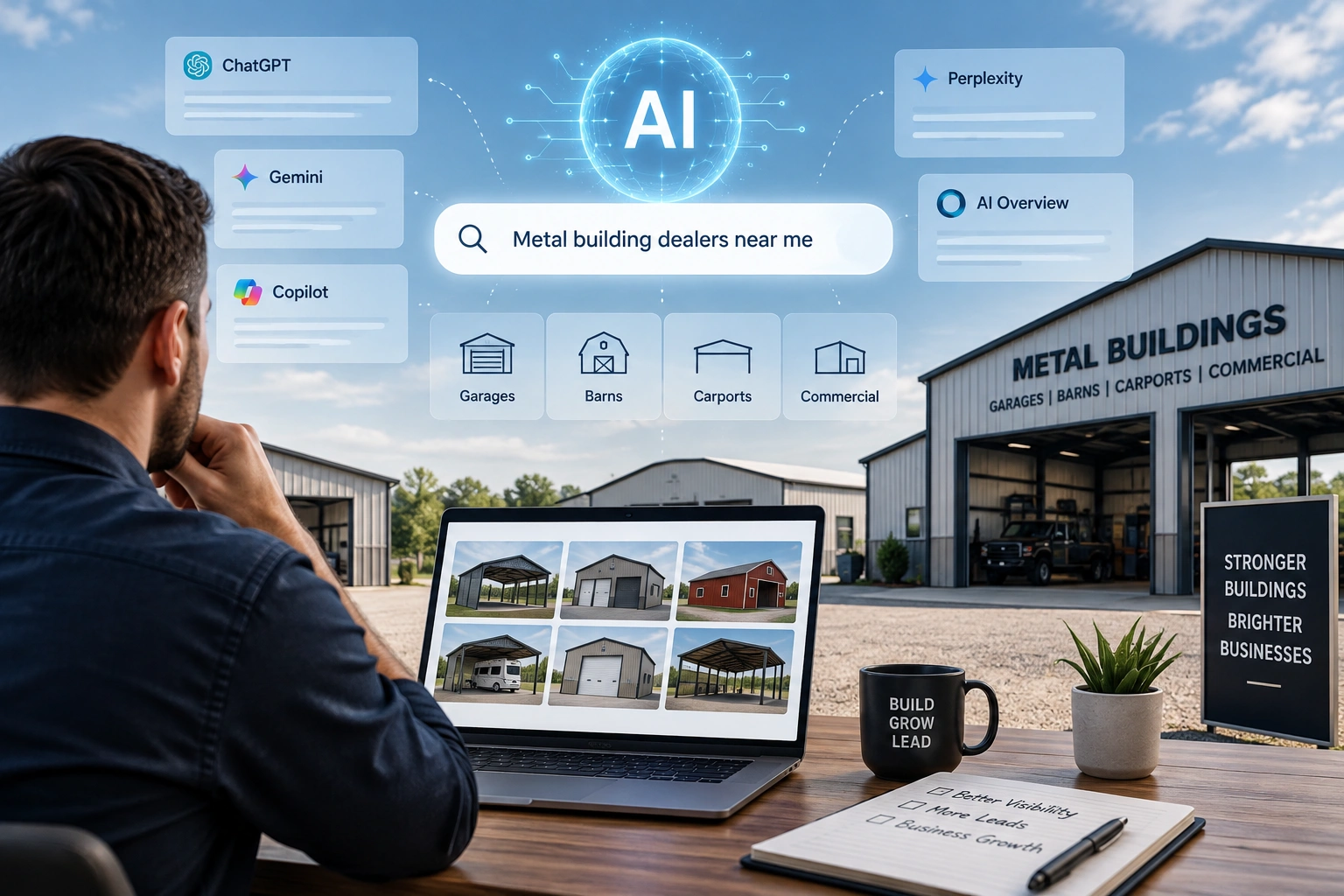
A customer in Ohio needs a 40×60 steel workshop. Instead of typing “metal building dealers near me” into Google and scrolling through ten blue links, they open ChatGPT and ask: “Who are the best metal building companies in Ohio for a workshop with a concrete slab included?”
The AI doesn’t show ten links. It answers, usually with two or three companies named directly. If your business isn’t one of them, that customer may never find you at all.
This is the new reality of search, and it’s exactly why “AI visibility” has become a topic every metal building dealer needs to understand.
What is AI Visibility (And Why Should You Care)?
AI visibility is your business’s ability to be found, understood, and recommended by AI-powered tools like ChatGPT, Google’s AI Overviews, Gemini, and Perplexity, not just by traditional search engines.
Traditional SEO was built around ranking a webpage for a keyword. AI visibility is different. AI systems read across your entire website, your reviews, your business listings, and mentions of your brand across the internet, then synthesize all of it into a single, direct answer for the person asking. There’s no page of ten results to skim. There’s one answer, and a handful of businesses that get named in it.
For a metal building dealer, this means the goal is no longer just “rank on page one.” The goal is to become the answer the AI gives when someone asks about steel buildings, pole barns, metal garages, or agricultural buildings in your service area.
Why AI Visibility Matters for Metal Building Dealers
Metal building buyers do a lot of research before they ever call a dealer. They’re comparing gauge of steel, foundation options, insulation, permitting requirements, financing, and delivery timelines, often across multiple states or provinces. That research increasingly starts with an AI chat instead of a search bar.
If your website has strong content but AI systems can’t easily find, trust, or cite it, you become invisible at the exact moment a buyer is deciding who to call. Meanwhile, a competitor with clear, well-structured content about their metal garages or commercial buildings gets named as the recommended option, even if their buildings aren’t necessarily better.
AI visibility matters because it directly affects:
- Whether your company gets mentioned when someone asks “who sells metal buildings in [state/province]”
- Whether your specific buildings (carports, garages, workshops, barns, commercial steel structures) get recommended for the right use case
- Whether your brand is seen as a credible, trustworthy source versus just another listing
- Whether you get found by out-of-area buyers who are shipping or having a building delivered
How AI Search is Changing Customer Discovery
A decade ago, discovery meant showing up in a Google search or a local directory. Today, discovery happens in layers:
- Traditional search: someone still searches “steel building prices” on Google.
- AI Overviews and AI-generated summaries: Google itself now generates a summary answer above the traditional results, often pulling from a small number of sources.
- Conversational AI tools: ChatGPT, Gemini, Perplexity, and similar tools are asked direct questions and give direct answers, sometimes with sources, sometimes without.
At each layer, AI is doing more of the work customers used to do themselves, comparing options, reading reviews, and narrowing down a shortlist. That means your online presence needs to be built so AI systems can easily extract facts about your business: what you sell, where you operate, what makes you different, and why you can be trusted.
AEO vs. GEO: What Metal Building Dealers Need to Know
You’ll see two acronyms alongside SEO: AEO and GEO.
AEO (Answer Engine Optimization) is about structuring your content so it directly answers specific questions, the way a customer would ask them. Instead of a vague page titled “Our Buildings,” AEO favors content structured around real questions like “How much does a 30×40 metal building cost installed?” or “Do I need a permit for a pole barn in Texas?”
GEO (Generative Engine Optimization) is about making sure AI tools can find, trust, and choose to cite your content when generating an answer. This includes having consistent, accurate information across your website and other platforms, being mentioned by credible third parties, and having content structured in a way machines can parse (not just humans).
Think of it this way: AEO is about writing the right content. GEO is about making sure AI systems can discover that content and feel confident enough in it to actually mention your name. Metal building dealers need both: strong answers, delivered in a way AI can find and trust.
The AI Visibility Checklist for Metal Building Dealers
Use this checklist to evaluate where your website and online presence currently stand, and where the gaps are.
1. Website and Technical Foundation
Your website needs a clean structure that both people and AI crawlers can navigate easily: clear page titles, logical menus, and fast-loading pages. If AI tools struggle to crawl or understand your site, they’ll pull information from somewhere else, like a competitor’s site or a third-party directory, instead.
Example: Make sure your product pages for carports, garages, barns, and commercial buildings are each their own clearly titled page rather than buried in a single generic “products” page.
2. Clear and Helpful Content Written for Questions, Not Just Keywords
Write content the way your customers actually talk. Instead of stuffing a page with the keyword “metal buildings,” build content around real conversations: “What size metal building do I need for a two-car garage and a workshop?” or “Is a metal building cheaper than wood framing for a barn?”
AI models are trained to match natural questions to natural answers. A page written as a helpful conversation performs better in AI search than one written purely for keyword density.
3. Service and Product Information
Be explicit about what you offer: sizes, gauges, roof styles, colors, insulation options, foundation types, and add-ons like walk-in doors or windows. Vague descriptions (“quality buildings at great prices”) give AI nothing concrete to cite. Specific, factual details (“14-gauge steel garages available in widths from 20 to 40 feet”) give AI something it can confidently repeat to a customer.
4. Location and Local Relevance
If you serve multiple states, provinces, or regions, say so clearly and specifically. Create location-specific content when it’s genuinely useful, for example, permitting notes that differ by state, or delivery zones. AI tools rely heavily on location signals to match a buyer’s question (“metal building dealer near Lubbock, Texas”) with the right business.
5. Business and Entity Information
AI systems try to understand your business as an “entity”: a real, verifiable company with a name, location, history, and area of expertise. Make sure your business name, address, phone number, and description are complete and consistent on your website’s About page, not just buried in the footer.
6. Structured Data and Schema Markup
Structured data (schema markup) is behind-the-scenes code that helps search engines and other systems interpret the important information on a page: it can clarify things like your products, your business details, breadcrumb navigation, and content that qualifies for FAQ display. It doesn’t change how your page looks to a visitor, but it gives AI systems a much clearer, machine-readable understanding of your site. Schema markup doesn’t guarantee AI visibility or citations, but it does strengthen how confidently machines can read and use your content, which can improve your odds of being cited accurately.
Example: Adding FAQ schema to a page answering, “How long does it take to install a metal building?” helps AI tools pull that exact answer with confidence.
7. Authoritativeness and Trust Signals
Show your expertise, not just your inventory. Author bios, years in business, certifications, project photos, and case studies all signal that your content comes from real, first-hand experience, not a generic template. AI systems are more likely to trust and cite sources that clearly demonstrate expertise.
8. Online Mentions and Citations
Your brand doesn’t just need to be findable on your own website. It needs to be mentioned elsewhere: local news, industry associations, supplier partner pages, guest posts, and community forums related to agriculture, construction, or rural living. Every credible mention gives AI another reason to trust and surface your name.
9. Reviews and Reputation
AI tools increasingly draw on reviews and overall sentiment when deciding which businesses to recommend. Actively collect and respond to reviews on Google Business Profile and relevant industry sites. A steady stream of recent, detailed reviews (mentioning specific products like “pole barn” or “steel garage”) gives AI concrete signals to work with.
10. Third-Party Websites and Industry References
Being listed accurately on industry directories, supplier or manufacturer sites, Better Business Bureau, and local chamber of commerce pages adds credibility that AI systems can cross-reference. Consistency matters here: if your business name, address, or phone number differs across these listings, it creates confusion that can quietly hurt your visibility.
11. Content Designed to Answer Customer Questions
Build out a genuine content library, not a single blog post, but an ongoing resource covering the real questions metal building buyers ask for financing options, HOA restrictions, insulation for different climates, foundation requirements, and comparisons between building types. A single well-optimized page can help, but topical depth across many pages is what builds the authority AI systems look for.
12. Comparison and Decision-Support Content
Create content that helps someone choose between options: “Steel Building vs. Wood Barn: Which Is Right for Your Farm?” or “Best Metal Building Sizes for a Two-Car Garage vs. a Workshop.” This kind of comparison content maps directly to how people phrase questions to AI tools, and it positions your business as the source that helped them decide.
13. Internal Linking and Website Structure
Link related content together: connect your blog post about pole barn financing to your pole barn product page and connect your product page to relevant FAQs. This helps both customers and AI systems understand how your content fits together and reinforces which pages are most important.
14. Measurement and Ongoing Optimization
AI visibility isn’t a one-time project. Regularly test the actual questions your customers might ask in ChatGPT, Gemini, or Google’s AI Overviews, and see whether your business shows up and how it’s described. Keep your most important pages (pricing, FAQs, product specs) updated, since AI tools tend to favor fresh, accurate information over outdated content.
Common AI Visibility Mistakes Metal Building Dealers Should Avoid
- One page trying to do everything: A single static “Products” page can’t compete with detailed, individual pages built for each building type. AI systems need specifics to cite, and one crowded page rarely gives them enough to work with.
- Vague, promotional language instead of real substance: Phrases like “best quality, best prices” tell AI nothing useful. Specific, factual details (sizes, materials, pricing ranges, use cases) are what get cited.
- Inconsistent business information everywhere: When your website, Google Business Profile, and directory listings don’t match, AI systems lose confidence in your business details and hesitate to recommend you.
- Ignoring or neglecting reviews: Unanswered reviews, good or bad, weaken the trust signals AI relies on when deciding who to mention.
- Treating AI visibility as a one-time fix: This isn’t a project you finish and forget. It’s an ongoing part of your marketing, just like SEO.
- Optimizing only for search engines, never checking AI answers: Ranking well on Google doesn’t guarantee AI tools mention you. Regularly test how your business shows up in AI-generated answers, so you catch gaps early.
How to Start Improving AI Visibility
You don’t need to tackle every checklist item at once. A practical starting point:
- Test a handful of real customer questions in ChatGPT or Gemini and see how your business currently shows up, if at all.
- Audit your product pages for specificity, sizes, materials, pricing ranges, and options.
- Add FAQ content and schema markup to your most important pages.
- Make sure your business information is identical across your website, Google Business Profile, and key directories.
- Build a plan to consistently collect and respond to customer reviews.
- Commit to publishing new, question-focused content on a regular schedule rather than one-off posts.
One important thing to keep in mind: there’s no guaranteed way to get your business mentioned by an AI tool, and no trick that forces it to happen. The smarter move is to focus on building a real, trustworthy online presence rather than trying to outsmart or game the system.
Putting It All Together
If your potential customers are turning to AI to find answers and businesses, your metal building company needs the content, authority, and online presence that AI systems can understand, trust, and confidently recommend. But here’s the key thing to understand: AI visibility isn’t a replacement for good SEO; it’s the next layer built on top of it. Your website still needs strong SEO fundamentals underneath everything else. The dealers who start building that foundation today will be the ones AI recommends when the next customer asks, “Who should I buy a metal building from?”