Why Most Metal Building Websites Fail to Generate Qualified Leads (And How to Fix It)

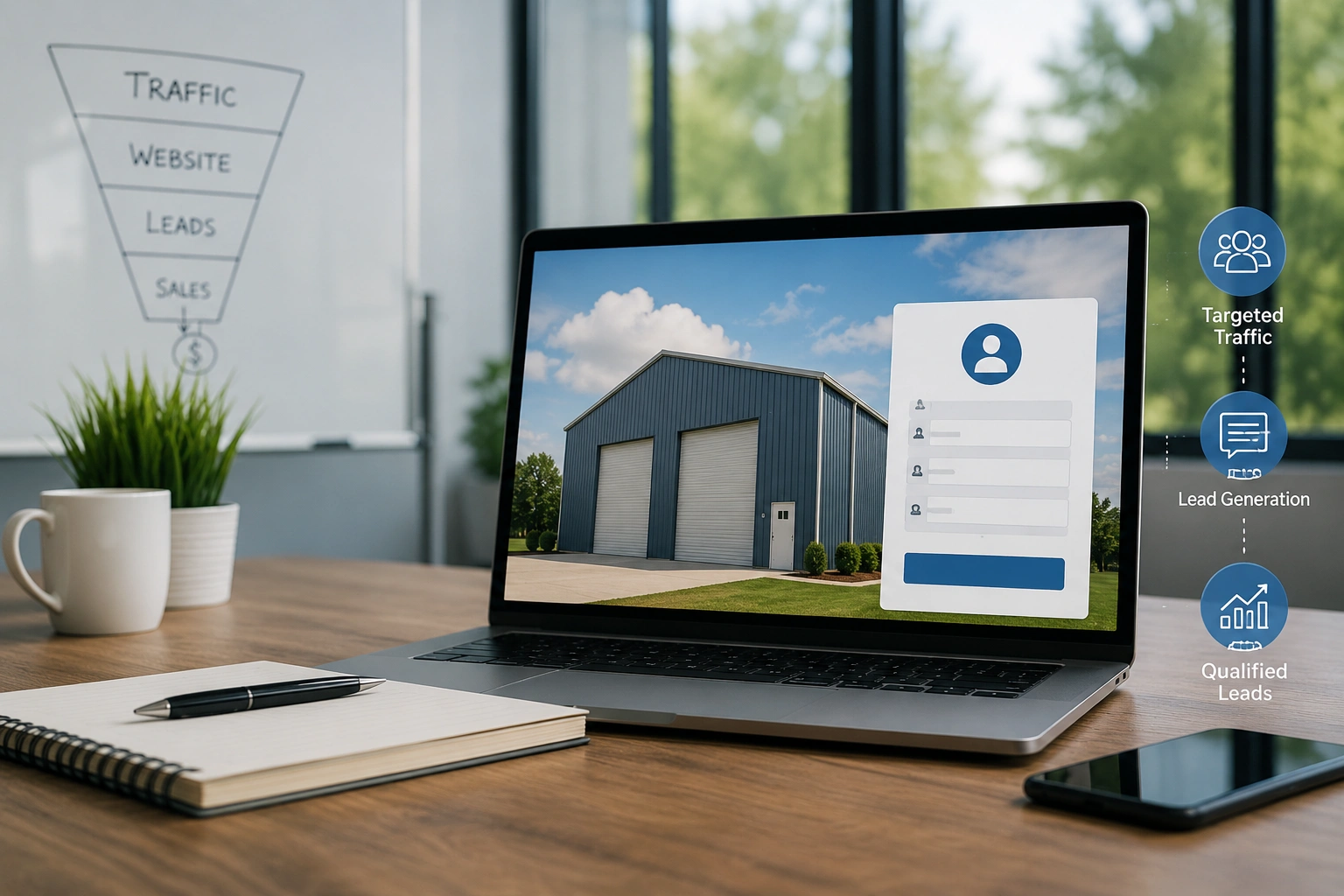
A steel building dealer in Texas told us he was spending $6,000 a month on Google Ads and getting over 400 clicks. His close rate? Four sales a month. His competitor, thirty miles down the highway, spent half that budget and closed twelve.
Same industry. Same market. Same weather-driven buying season. Completely different results.
The difference wasn’t the ad budget. It wasn’t even the product — both companies sold nearly identical carports, garages, and barns at comparable prices. The difference was what happened after someone clicked the ad and landed on the website.
This is the story we hear constantly from metal building dealers, manufacturers, and contractors across the country. You’re getting visitors. Maybe even a lot of them. But the phone isn’t ringing enough, the quote requests are full of tire-kickers, and the sales team keeps asking marketing why the “leads” they’re getting aren’t real buyers.
This article breaks down exactly why that happens — the specific, industry-relevant reasons metal building websites lose qualified buyers — and what to fix first, second, and third to turn your website into an actual sales tool instead of a digital brochure nobody acts on.
1. Why Traffic Alone Doesn’t Generate Sales
Metal building companies love to talk about traffic numbers. “We got 3,000 visitors last month.” That’s a vanity metric if the website isn’t built to convert that traffic into phone calls, form fills, and chat conversations.
Here’s the math that matters: if your website converts at 1% and you get 3,000 visitors, that’s 30 leads. If a competitor converts at 4% with half your traffic (1,500 visitors), they get 60 leads — double yours, with less spend on ads and SEO.
The industry average website conversion rate across most sectors sits between 2% and 3%, according to data commonly cited by conversion research firms like WordStream and Unbounce. Many metal building websites we’ve audited convert well below 1%. That gap is not a traffic problem. It’s a website problem.
Bringing more people to a broken sales process just means more people see the broken process. Fix the website first. Then scale the traffic.
2. Poor Website Design and User Experience
Walk through a typical metal building website homepage and you’ll often find the same pattern: a stock photo of a red barn, a navigation menu with twelve links, no clear starting point, and a “Contact Us” button buried in the footer.
Buyers researching a carport, garage, or agricultural building are usually comparing three to five companies in one sitting. If your site doesn’t answer “what do you build, where do you build it, and how much does it cost” within the first ten seconds, they move to the next tab.
Common design problems we see in this industry:
- Homepages built around the company instead of the buyer’s decision
- No clear path from homepage to pricing or quote request
- Cluttered menus with 10+ items and no obvious priority
- Outdated templates from builder platforms that look identical to five other dealers in the same state
- No visual hierarchy — everything competes for attention at once
Fix: Build the homepage around three questions every visitor is silently asking: What do you build? Do you serve my area? What will it cost? Answer those visually, above the fold, before anything else.
3. Slow Page Speed and Mobile Usability Issues
Metal building buyers are frequently on a job site, in a truck, or standing in a field looking at where the building will go. That means they’re on a phone, often with average signal.
Google’s own research has found that as page load time goes from one second to five seconds, the probability of a mobile visitor leaving increases significantly. If your product pages are loaded with unoptimized images of buildings (which, ironically, are often large, high-resolution photo files), that’s exactly the kind of page weight that kills load times.
Common mobile issues in metal building sites:
- Pricing calculators or configurators that don’t render correctly on phones
- Forms that are difficult to fill out with a thumb
- Text that requires pinch-to-zoom
- Buttons placed too close together
- Pop-ups that cover the entire screen with no easy close button
Fix: Run your site through Google PageSpeed Insights and Google’s Mobile-Friendly Test. Compress images, use a content delivery network, and test the actual quote form on a real phone — not just in a desktop browser resized smaller.
4. Weak Calls-to-Action
“Learn More” is not a call-to-action. It’s a call to leave.
Metal building websites frequently rely on generic CTAs that don’t tell the visitor what happens next or why they should click. Compare these two:
- “Contact Us”
- “Get Your Free Quote in 60 Seconds”
The second one sets an expectation, reduces perceived effort, and gives a reason to act now instead of later.
Fix: Every page — homepage, product page, blog post — should have one primary CTA that’s specific, low-friction, and repeated at logical points (top, middle, bottom) rather than a single button hidden at the very end.
5. No Instant Quote or Pricing Tools
This is one of the biggest gaps in the industry, and it’s costing dealers real money.
Buyers researching a steel garage or barn want a ballpark price before they’ll pick up the phone. Many metal building websites hide pricing entirely, forcing visitors to “call for a quote.” That approach filters out serious buyers just as often as it filters out unqualified ones — because a large share of buyers will simply visit a competitor who shows a starting price or offers an instant estimate.
What works instead:
- A size-and-style configurator that gives a real-time price range
- Clear “starting at” pricing on standard building sizes
- A simple quote form that asks for size, use case, and location, then promises a callback within a set time frame
Companies that added even a basic price range calculator to their site have reported meaningful increases in quote requests, because it removes the biggest point of hesitation: not knowing if the product is even in a buyer’s budget before they commit time to a phone call.
6. Poor Lead Forms and Lack of Trust Signals
A ten-field form asking for full address, best time to call, project timeline, budget range, and how they heard about you is a conversion killer. Every additional field reduces completion rates.
At the same time, a form with zero context — no mention of licensing, insurance, years in business, or number of buildings installed — gives a first-time visitor no reason to trust you with their information.
Fix:
- Cut forms down to name, phone, zip code, and building type. Ask everything else on the follow-up call.
- Add trust markers directly next to the form: years in business, number of buildings installed, BBB rating, state licensing, or manufacturer certifications (if you’re a dealer for a certified building brand).
- Include a privacy reassurance line like “We’ll never sell your information” next to the submit button.
7. Missing Project Galleries and Customer Testimonials
Metal buildings are a visual, high-consideration purchase. Buyers want to see real installations that resemble what they’re picturing for their own property — not just stock renderings.
Websites that only show manufacturer stock photos lose credibility fast, especially compared to competitors showing actual completed jobs with before/after shots, customer names, and locations.
Fix:
- Build a searchable or filterable gallery by building type, size, and state
- Include short written or video testimonials tied to specific projects
- Add location context (“Installed in Lubbock, TX — 30×40 workshop”) since local relevance builds trust and helps local SEO
8. Lack of Financing Information
A large share of metal building purchases — garages, barns, workshops, commercial buildings — are financed rather than paid in cash. If your website doesn’t mention financing options, buyers on a monthly-payment budget may assume the product is out of reach and leave without ever finding out otherwise.
Fix: Add a dedicated financing page explaining available options, estimated monthly payments for common sizes, and a simple pre-qualification form. Even a basic “Financing Available — See If You Qualify” banner on product pages can noticeably improve engagement.
9. Poor Local SEO
Most metal building purchases are inherently local — buyers want a company that delivers and installs in their specific county or region. Yet many company websites are built around one generic “Locations We Serve” page listing twenty counties in a single paragraph, which does almost nothing for search visibility.
Local SEO for metal building companies requires far more structure than that. Google needs individual signals tying your business to each specific market you serve.
Common local SEO gaps:
- No dedicated page per service area
- Inconsistent business name, address, and phone number (NAP) across directories
- No local schema markup
- No city or region-specific content anywhere on the site
10. Weak Google Business Profile Optimization
Your Google Business Profile is often the first thing a local buyer sees — before they even click through to your website. Many metal building dealers either haven’t claimed their profile, have incomplete information, or ignore it after initial setup.
Fix:
- Fully complete every section: categories, service areas, hours, attributes
- Upload real project photos regularly, not just a logo
- Respond to every review, positive or negative
- Post updates and specials through Google Posts to stay active in the algorithm
- Make sure your primary category is accurate (e.g., “Metal Fabricator” vs. “Building Materials Store” vs. “Construction Company” — these matter for which searches you show up in)
A complete, active Business Profile is often the single highest-leverage local SEO asset a metal building company has, because it sits directly next to the map pack results most local buyers click first.
11. Thin or Duplicate Content
This is extremely common among dealers who use a manufacturer-provided website template. If your product page for a 30×40 barn reads nearly word-for-word the same as fifty other dealers using the same template, Google has little reason to rank you above them — and buyers have no reason to trust you specifically.
Fix: Rewrite product and service pages in your own voice, with your own pricing context, local delivery details, and installation process. Even 300-400 words of genuinely unique content per page makes a measurable difference over templated copy.
12. Poor Product Page Structure
A product page for a metal garage or barn needs to do a lot of work: explain sizing, gauge options, color choices, roof styles, permitting basics, and price ranges, while still pushing toward a quote request.
Too often, these pages either dump a spec sheet with no sales context, or go the opposite direction with vague marketing language and no actual product detail.
Fix a strong product page includes:
- Clear size and price range table
- Available customization options (colors, roof style, gauge, insulation)
- Delivery and installation processes specific to that product
- Photos of completed similar projects
- A quote CTA placed near the top, not just the bottom
13. Missing Service Area Pages
If you install buildings across multiple counties or states, each core service area deserves its own page — not just a mention in a footer list. A dedicated page for “Metal Buildings in [City, State]” with local delivery details, permitting notes specific to that jurisdiction, and local project photos gives Google (and buyers) a real reason to rank and trust that page for local searches.
This is one of the most overlooked opportunities to generate metal building, leads from search traffic that’s already looking for a local provider, not just researching generally.
14. Missing FAQs
Buyers researching metal buildings have predictable, recurring questions: Do I need a permit? What’s the difference between a carport and a garage in your terminology? How long does installation take? Do you deliver to my area? What if the ground isn’t level?
A well-built FAQ section does two things at once: it answers objections that would otherwise stop someone from filling out a form, and it captures long-tail search traffic from people typing those exact questions into Google.
15. Technical SEO Issues
Beyond content and design, a large share of metal building websites carries technical problems that quietly suppress rankings:
- Missing or duplicate title tags and meta descriptions across product pages
- No structured data (schema) for local business, products, or reviews
- Broken internal links, especially after template or platform migrations
- Non-secure (HTTP instead of HTTPS) pages
- Orphaned pages with no internal links pointing to them
- Missing or incorrect XML sitemaps
These issues rarely show up at a casual glance at the website, but they show up clearly in a full technical audit — and they compound over time, slowly eroding visibility even as competitors gain ground.
16. Weak Conversion Rate Optimization for Metal Building Websites
Conversion rate optimization for metal building websites is about testing and refining what actually gets a visitor to act — not just guessing. Most dealer and manufacturer sites we review have never run a single structured test on their homepage, forms, or CTAs.
Simple CRO fixes with outsized impact:
- Move the primary CTA above the fold on every key page
- Add urgency where genuinely true (“Spring installation slots filling up”)
- Test one-step forms against multi-step forms
- Add exit-intent offers for visitors about to leave without converting
- Use heatmaps to see where visitors actually click and scroll versus where you assume they do
17. Poor Google Ads Landing Pages
Sending paid traffic to a generic homepage instead of a dedicated, matching landing page is one of the most expensive mistakes we see. If someone searches for “steel carport prices near me” and clicks an ad, they should land on a page about steel carport prices in their area — not a homepage covering ten different product lines.
Fix: Build dedicated landing pages per campaign that match search intent exactly, include a fast-loading price estimate or quote form, strip out unnecessary navigation that lets visitors wander off, and keep messaging consistent with the ad copy that got the click.
Mismatched ad-to-landing-page experiences are also a major reason Google Ads Quality Scores stay low, which directly increases cost per click.
18. No Visitor Tracking or Analytics
You can’t fix what you can’t measure. Many metal building companies run ad campaigns and SEO efforts with Google Analytics either not installed correctly, not tracking form submissions and calls as conversions, or never reviewed at all.
Fix: Set up conversion tracking for every meaningful action — form submissions, phone calls (via call tracking), chat starts, and quote tool completions — so you know exactly which channels and pages are actually producing leads, not just traffic.
19. Failure to Nurture Leads Through Email or CRM Automation
Not every visitor is ready to buy the day they fill out a form. Metal buildings are often considered a purchase involving permits, budget approval, or seasonal timing. If a lead comes in and only gets one follow-up call before going cold, you’re losing sales that a proper nurture sequence would have closed weeks later.
Fix: Use a CRM to automatically follow up with email and text sequences that answer common objections, share financing options, and remind leads of your availability — without relying purely on manual follow-up from a busy sales team.
20. Missing Chatbots and Instant Quote Assistants
Buyers browsing at 9 p.m. after work aren’t going to call your office. If there’s no way to get a quick answer or start a quote outside business hours, that visitor often moves to a competitor’s site instead.
A chatbot or instant quote assistant on the site can capture basic project details, answer common questions, and hand off qualified conversations to your sales team the next morning — turning after-hours browsing into next-day appointments instead of lost traffic.
Key Takeaways
- Traffic without conversion capability is wasted ad spend and wasted SEO effort.
- Buyers want fast answers on price, service area, and trust before they’ll call.
- Local SEO and a fully built-out Google Business Profile matter as much as, if not more than, general SEO for this industry.
- Product and service pages need unique, specific content — not manufacturer templates.
- Conversion rate optimization for metal building websites is an ongoing process, not a one-time fix.
- Lead nurturing through CRM automation captures sales that manual follow-up alone will miss.
Conclusion
None of these problems exist in isolation. A metal building website that’s slow, hides pricing, has weak local SEO, and never follows up on leads isn’t failing for one reason — it’s failing because every stage of the visitor’s journey has friction built into it.
The good news is that each of these issues is fixable and fixing them compounds. A faster site with clear pricing and strong local SEO doesn’t just convert better — it also earns more organic traffic and lowers the cost of every paid click.
We work exclusively with metal building manufacturers, dealers, and contractors across the United States, which means every recommendation above comes from problems we’ve diagnosed and fixed directly in this industry — not generic marketing advice applied to a steel building website after the fact.
Frequently Asked Questions
1. Why does my metal building website get traffic but no leads?
Traffic problems and conversion problems are different issues. If visitors arrive but don’t act, the likely causes are unclear pricing, weak calls-to-action, slow load times, or a lead form that asks for too much information too soon.
2. How much does a metal building website redesign typically cost?
Costs vary widely based on scope, but a properly built site with a quote configurator, local SEO structure, and CRO-focused design generally represents a meaningful investment upfront that pays back through higher close rates and lower long-term ad costs.
3. Should I show pricing on my metal building website?
Yes, in most cases. Showing at least a starting price range or an instant estimate tool builds trust and filters in serious buyers, while hiding all pricing tends to filter out buyers who assume the product is outside their budget.
4. What’s the fastest way to improve local SEO for a metal building company?
Start with a fully completed and actively managed Google Business Profile, followed by dedicated service area pages for each city or county you serve, and consistent business information across all directories.
5. How important is mobile design for metal building websites?
Very. A large share of buyers research on their phones, often from a job site or property. If forms, quote tools, or navigation don’t work smoothly on mobile, you’re losing leads before they ever reach your sales team.
6. Do I need a chatbot on my metal building website?
It’s not required, but it captures leads outside business hours that would otherwise be lost, and it gives buyers a low-effort way to get quick answers before committing to a phone call.
7. How long does it take to see results from metal building SEO?
Meaningful organic ranking improvements typically take three to six months, depending on competition in your market and the current state of your site’s technical and content foundation. Local SEO and Google Business Profile improvements can show results faster.
8. What’s the difference between metal building SEO and running Google Ads?
SEO builds long-term, ongoing visibility in organic search results without a per-click cost, while Google Ads generates immediate visibility for a direct cost per click. Most successful metal building marketing strategies use both together.
9. Why are my Google Ads expensive with few conversions?
This is often caused by sending ad traffic to a generic homepage instead of a dedicated landing page that matches the exact search intent, along with weak Quality Scores from that mismatch.
10. How do I know if my website’s conversion rate is actually a problem?
Compare your form submissions, calls, and chat starts against your total traffic. If you’re converting well below 2%, there’s meaningful room for improvement through design, trust signals, and calls-to-action tailored to metal building buyers.