Local SEO Checklist for Metal Building Companies

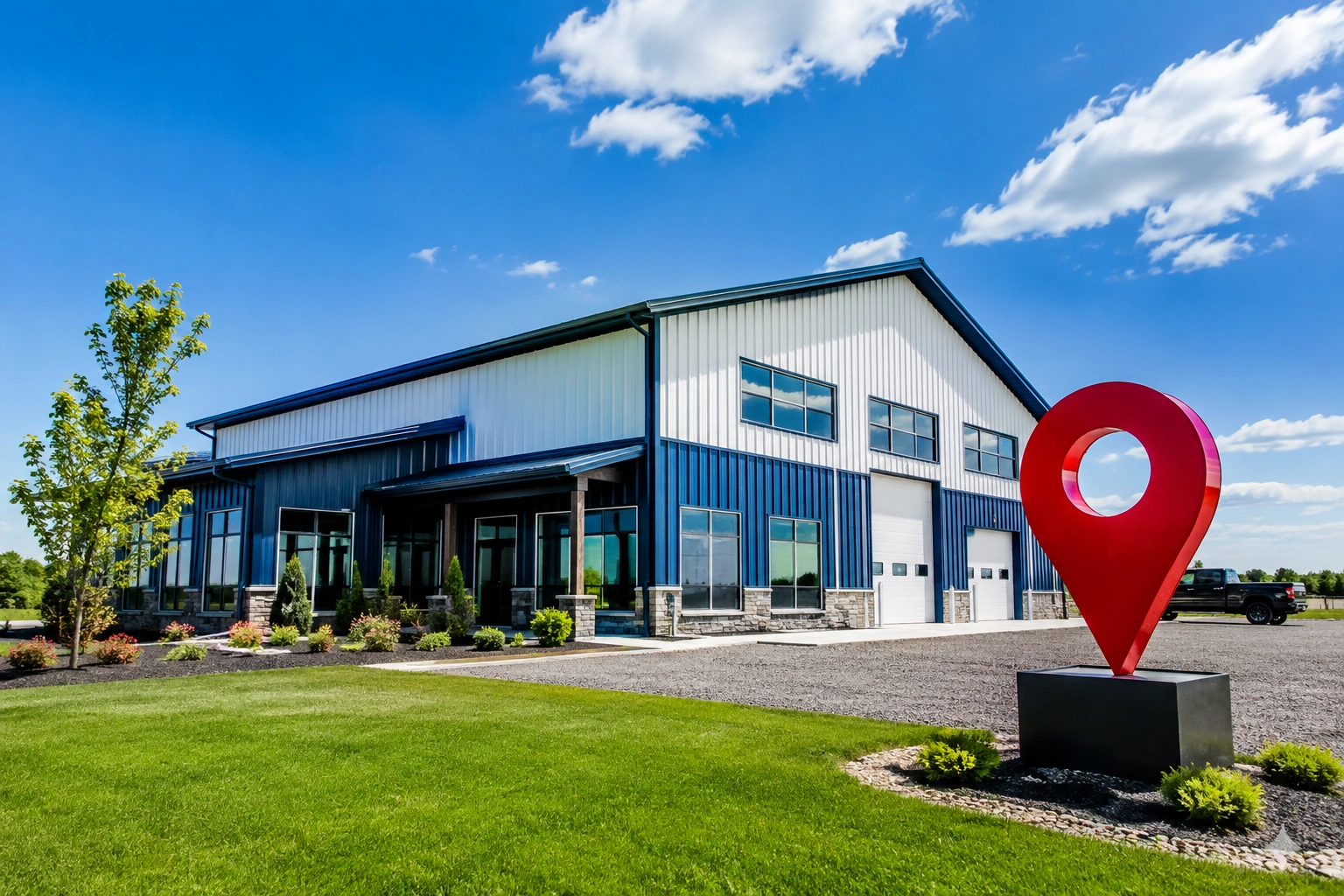
If you sell or build metal buildings, most of your customers are searching for you by location. Someone in Amarillo, Texas, typing “metal building builder near me” doesn’t want a company three states away. They want someone local who can quote them fast, deliver them on time, and stand behind their work.
That’s exactly what local SEO does. It helps your business show up when people in your service area search for what you offer, whether that’s a Google search, a map result, or a “near me” query on a phone.
Below is a full checklist you can use to build out or clean up your local SEO, step by step.
1. Research What’s Already Ranking in Your Area
Before changing anything on your own site, search the terms your customers would type, such as “steel building company [your city]” or “pole barn builder near me,” and see who shows up in the map pack and the regular results.
Look at the three or four businesses ranking above you and ask:
- How many reviews do they have, and what’s their average rating?
- What categories are they listed under on Google Business Profile?
- Do they have separate pages for different cities or just one general page?
- What kind of photos are they using?
This isn’t about copying them. It’s about knowing what you’re competing against, so you’re not guessing what “good” looks like in your market. If a competitor with 200 reviews outranks you and you have 12, that gap tells you exactly where to put your effort first.
2. Claim and Fully Complete Your Google Business Profile
This is the single most important piece of local SEO for a metal building company. Your Google Business Profile is what shows up in the map pack (the three business listings that appear above regular search results) when someone searches for a builder near them.
Make sure you:
- Use your real business name, not a keyword-stuffed version
- Choose accurate business categories, such as “Steel building supplier” or “Building contractor”
- Add your service areas if you travel to build (not just a single address)
- Upload real photos of completed projects, not stock images
- Fill out your business hours, phone number, and website link
- Write a clear business description explaining what you build and where you serve
Example: A company called “Lone Star Metal Buildings” serving five counties in Texas should list all five service areas in their profile, not just the city where their office sits. That way they show up in searches from nearby towns too.
Setting up the profile is only step one. Google likes listings that stay active, so treat your profile as something you update regularly, not something you fill out once and forget.
Keep it active by:
- Posting a short update after finishing a project, with a photo and a line about the location
- Uploading new photos every few weeks instead of a batch once a year
- Answering the “Questions and Answers” section visitors leave on your listing
- Updating your hours around holidays so they’re never wrong
A profile that gets weekly attention tends to hold its ranking better than one that was set up well but hasn’t changed in two years.
3. Keep Your Business Name, Address, and Phone Number Consistent Everywhere
This is often called NAP consistency (Name, Address, Phone number). Search engines check whether your business information matches across your website, Google Business Profile, Facebook page, and any online directories.
If your website says “123 Main St.” but your Google listing says “123 Main Street,” that small mismatch can quietly hurt your local rankings.
What to check:
- Website footer area and the contact page
- Google Business Profile
- Facebook, Yelp, and Better Business Bureau listings
- Industry directories (steel building associations, contractor listings, etc.)
4. Build Location Pages for Each Area You Serve
If your company serves more than one city, county, or state, don’t rely on a single generic homepage to rank everywhere. Create individual pages for each major service area.
Example: Instead of one page that says, “We serve the Midwest,” create separate pages like:
- Metal Buildings in Springfield, Missouri
- Metal Buildings in Joplin, Missouri
- Metal Buildings in Fayetteville, Arkansas
Each page should include local details such as permit requirements, delivery timelines for that area, and photos of projects built nearby. Avoid copying and pasting the same content across every page with just the city name swapped. Search engines can tell, and it won’t help your rankings.
5. Use Local Keywords Naturally Throughout Your Site
People search in different ways depending on what they need. Some common search patterns for this industry include:
- “metal building prices [city]”
- “steel barn builder near me”
- “pole barn contractor [state]”
- “commercial steel building company [region]”
Work these kinds of phrases naturally into your page titles, headings, and body content. Don’t force them in unnaturally or repeat them so often that the writing sounds odd. One well-placed mention in a heading and a couple more in the body text is usually enough.
6. Collect Reviews, and Use Them the Right Way
Reviews affect both local rankings and buyer trust. A metal building is a big purchase, and buyers often check reviews before ever calling you.
A simple process to follow:
- After a project is completed, send a short text or email asking for a review
- Include a direct link to your Google review page so it takes one click
- Respond to every review, good or bad, in a polite and professional tone
- Mention your city or service area naturally when responding (for example, “Thanks for trusting us with your new shop building in Tulsa”)
That last point matters more than people realize. Google reads the text in your review responses too, and mentioning your location again reinforces where you do business.
Handling a negative review: Don’t delete it or argue in the comments. Respond calmly, acknowledge the concern, and offer to fix it offline with a phone number or email. A business with a handful of well-handled negative reviews often looks more trustworthy to buyers than one with a perfect score and no history at all, since a spotless record can look staged.
Mine your reviews for keywords: Read through what customers write. If several mention “carport,” “workshop,” or “hay barn” instead of the term you use on your site, those are real words your buyers search with. Work them into your website content and location pages so your language matches how people talk about your buildings.
7. Get Listed in Local and Industry Directories
Beyond Google, your business should appear in a handful of trusted directories. These are sometimes called citations, and they help confirm to search engines that your business is real and active in a specific area.
Good places to get listed include:
- Local chamber of commerce websites
- Better Business Bureau
- Industry-specific directories for steel or metal building suppliers
- State contractor licensing directories, if applicable
- Local news or business association websites
Just make sure your business name, address, and phone number match exactly what’s on your website and Google profile.
8. Build Local Backlinks, Not Just Directory Listings
A backlink is when another website links to yours. Local backlinks, meaning links from websites tied to your area, carry extra weight for local rankings because they confirm to search engines that real local businesses and organizations recognize you.
Ways to earn them that fit this industry:
- Sponsor a local youth sports team, county fair, or FFA chapter; most will link to your site from their sponsor’s page
- Ask suppliers or steel manufacturers you work with to list you on their dealer or contractor page
- Offer a short expert quote to a local news reporter covering a story on construction, agriculture, or small business
- Join your local chamber of commerce, which usually includes a listing with a link
- Write a guest post for a local trade association or farming publication if you have useful project experience to share
You don’t need dozens of these. A handful of genuine, relevant local links usually do more for your rankings than a long list of low-quality directory submissions.
9. Get More Value from the Photos You Already Have
Metal building companies tend to have plenty of project photos, but most sites waste that content. Search engines can’t see a photo; they read the file name and the alt text around it, so unlabeled files like “IMG_4521.jpg” carry zero local SEO value.
Simple fixes:
- Rename image files before uploading, for example “40×60-steel-building-springfield-mo.jpg” instead of “IMG_4521.jpg”
- Add alt text describing the building type and location, such as “Red metal barn built for a horse farm in Joplin, Missouri”
- Compress images so they load fast; large unoptimized photos slow down your site and hurt both rankings and the visitor’s experience
- Add a short caption under key photos on location pages mentioning the city or project type
This is a small task most companies skip, and it’s one of the easier wins on this whole list.
10. Add Local Schema Markup to Your Website
Schema markup is a bit of code added to your website that helps search engines understand details about your business, such as your address, phone number, service area, and hours. It doesn’t change what visitors see on the page, but it helps search engines display your information correctly in search results.
If you’re not comfortable adding this yourself, your web developer or marketing team can add Local Business schema to your homepage and contact page in a short amount of time.
11. Make Sure Your Website Works Well on Mobile
A large share of local searches happens on phones, often from someone standing on their property measuring space for a new building. If your site is slow, hard to read, or your contact information is hard to find on mobile, you’ll lose that visitor to a competitor.
Quick checks:
- Does your phone number appear as a clickable link on mobile?
- Does your quote form load quickly and work without zooming in?
- Are your location pages easy to read on a small screen?
12. Publish Content That Answers Local Questions
Buyers research before they call. Blog posts and guides that answer common local questions can help your site show up for searches you’d otherwise miss.
Example topics:
- “Do I need a permit for a metal building in [state]?”
- “How much does a 40×60 steel building cost in [region]?”
- “Snow load requirements for metal buildings in [state]”
This kind of content brings in visitors who are actively researching a purchase, not just browsing.
13. Avoid These Common Local SEO Mistakes
A few mistakes show up again and again in this industry and can undo the work above:
- Running multiple Google Business Profile listings for one location. This usually happens by accident when someone creates a new listing instead of claiming the existing one. Duplicate listings split your reviews and confuse rankings.
- Stuffing keywords into your business name on Google. Listing your business as “ABC Metal Buildings – Best Steel Buildings Springfield MO” instead of your real name violates Google’s rules and can get your listing suspended.
- Choosing the wrong or too many categories. Piling on unrelated categories to try to rank for everything usually backfires. Stick to categories that genuinely describe your business.
- Ignoring service area settings. If you build across a wide region but only ever set a single pin address, you’re invisible to searches from your other service towns.
- Letting old locations or phone numbers linger online. If you moved offices or changed numbers, outdated listings still floating around online create the NAP mismatches mentioned earlier.
14. Track Your Local Search Performance
Once your local SEO work is in place, keep an eye on how it performs. A few simple things to track:
- Your ranking position in the map pack for target search terms
- How many calls or form submissions come from your Google Business Profile
- Which location pages bring in the most traffic
- New reviews and their overall rating trend
You don’t need complicated tools to start. Google Business Profile has built-in reports, and Google Search Console can show you which local search terms are bringing people to your site.
Key Takeaways
Local SEO isn’t a one-time task. It’s a set of ongoing habits: keeping your listings accurate, gathering reviews, publishing useful content, watching what competitors are doing, and making sure your website gives local buyers what they need to take the next step.
For a metal building company, most customers are searching close to home. If your local SEO is solid, you show up in front of them at the exact moment they’re ready to buy. If it’s not, that same buyer ends up calling a competitor instead.
Not sure where your local SEO stands right now? A quick audit of your Google Business Profile and website can show you exactly what’s missing and what to fix first.