How to Build a High-Converting Website for Your Metal Building Company

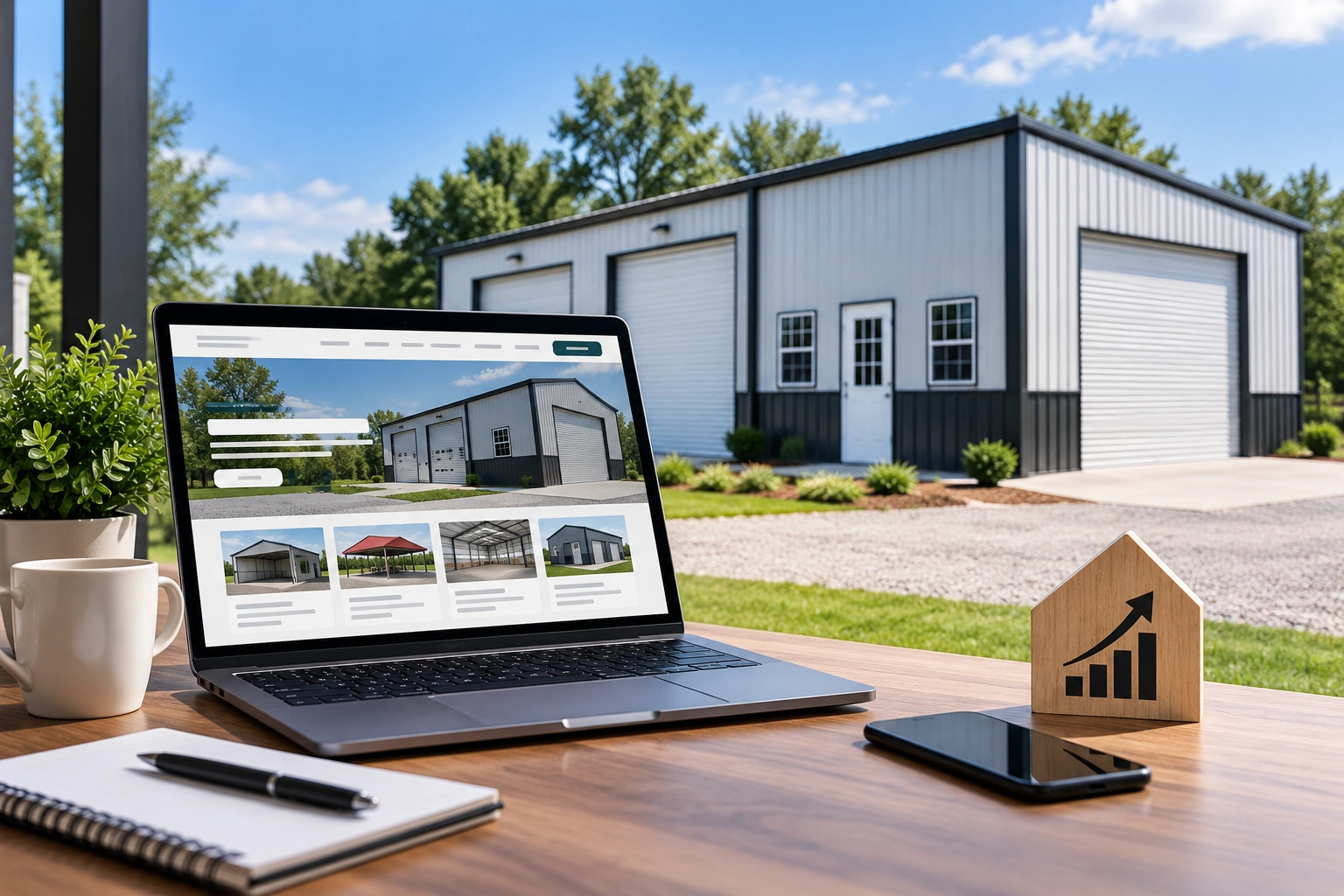
A metal building dealer puts real money into a new website. The photos are sharp, the logo looks sharp, the colors match the truck wraps. Six months later, traffic is decent, but the phone barely rings, and the quote form sits mostly empty. The owner assumes the fix is more traffic. Usually, it isn’t.
The real problem is almost always what happens after someone lands on the site. Can they tell what sizes you carry? Can they figure out if you install in their county? Do they know roughly what a 30×40 metal garage costs before they’re asked to fill out a form? If the answer to any of that is no, more traffic just means more people leaving confused.
A high-converting metal building website is not the same thing as a good-looking metal building website. It’s a website built to move a visitor from “just looking” to “requesting a quote” without friction, guesswork, or dead ends. This article walks through how to build one, section by section, using the way metal building customers actually shop.
Understand Your Metal Building Customer
Before touching navigation menus or button colors, it helps to know what a customer goes through before they ever fill out a form.
Awareness: Someone realizes they need a structure. Maybe their tractor is sitting outside, their RV is getting sun-damaged, or they just bought five acres and need a barn before winter.
Research: They start searching terms like “metal garage sizes” or “how much does a steel building cost.” At this stage, they’re not ready to buy from anyone. They’re trying to understand the category.
Comparison: Now they’re looking at specific product types. A farmer comparing a pole barn against a metal barn. A homeowner comparing a carport against a fully enclosed garage. This is where they start noticing differences between dealers too.
Evaluation: They’ve narrowed it down and are checking specifics: does this company deliver to my zip code, do they offer the roof style I want, what’s their install timeline, do they have financing.
Quote request: They’re ready to talk numbers. This is the moment your website exists to create.
Sales conversation and purchase: The website’s job is mostly done here, but a good site sets up your sales team with a lead that already understands the product, so the call is shorter and more productive.
Here’s the part dealers miss: a single website has to serve all of these stages at once. Someone landing on your carport page from a Google search for “carport prices” is at a very different stage than someone who typed your business name directly into Google because a neighbor recommended you. Your structure and content need to work for both without forcing either one through the wrong path.
Build the Right Website Structure
A metal building website should be organized the way a customer thinks, not the way your internal team is organized. Customers think in product categories first, then specifics, then location.
A workable structure looks like this:
Home
→ Metal Buildings
→ Metal Garages
→ Metal Barns
→ Carports
→ RV Covers
→ Commercial Buildings
→ Locations
→ Resources
→ About
→ Contact
→ Get a Quote
A few things matter more than they seem to on the surface.
Navigation: Navigation should never bury your core products more than one click from the homepage. If someone has to hunt through a dropdown three levels deep to find “carports,” you’ve already lost some of them.
URLs: URLs should be readable and describe what’s on the page. A URL like yoursite.com/products/p-2847 tells Google and the visitor nothing. A URL like yoursite.com/metal-garages tells both exactly what to expect.
Breadcrumbs (the small trail of links at the top of a page): Breadcrumbs like Home > Metal Buildings > Metal Garages) help visitors understand where they are and help them backtrack without hitting the browser’s back button. They also help Google understand your site’s hierarchy.
Internal linking: Internal linking connects related pages. A metal garage product page should link to your Texas or Georgia location page if you serve that area, and your location pages should link back to the specific products available there. This does two things: it helps visitors find what they need faster, and it helps Google understand which pages are related and important.
Product pages and location pages should work together, not duplicate each other. A location page for “Metal Buildings in Oklahoma” shouldn’t just repeat your garage product page with the state name swapped in. It should talk about things specific to that area: permitting notes, wind and snow load requirements if relevant, delivery zones, and any local project examples.
Create Product Pages That Answer Buyer Questions
Your product pages carry the most weight in this entire website. This is where someone decides whether to keep browsing your competitor’s site or fill out your form.
A strong product page for something like a metal garage or a metal barn should cover:
- A clear overview of the product and what it’s built for
- Available sizes, including width, length, and height options
- Roof style choices (regular, A-frame, vertical)
- Wall options and gauge/material information
- Color options
- Door and window choices, including garage doors, walk-in doors, and window sizes
- Customization options
- Common uses for that building type
- What installation actually involves
- Delivery information, including any limitations on distance or terrain
- Warranty details
- Financing options, if you offer them
- Pricing or pricing guidance
- FAQs specific to that product
- Real project photos, not stock images
- Related products (a barn page linking to a carport page for someone who might need both)
- A clear quote request call to action
Notice how much of this list is just answering questions a buyer would ask on a phone call anyway. If your product page already covers building sizes, roof options, and rough pricing, your sales team spends less time repeating basic information and more time closing.
Pricing and Quote Strategy
This is where a lot of dealers get nervous. The instinct is to hide pricing entirely because “every building is different.” That instinct is understandable, but hiding pricing completely usually costs you more leads than it protects.
Metal building prices vary because of legitimate factors: size, your location, materials and gauge, customization, doors and windows, whether installation is included, delivery distance, site prep needs, and current material costs. All of that is true. But a buyer researching “30×40 metal garage cost” who gets zero pricing signal from your site will often just move to the next search result that gives them something to work with.
A few approaches that balance both concerns:
- Starting prices (“Metal garages starting at $X for a basic 20×20 unit”)
- Example configurations showing a realistic build with its price
- Price ranges by size category
- Request-a-quote forms for anything customized
- Online quote builders or configurators that let visitors pick size, roof style, and options and get an estimate before submitting contact information
None of these require you to publish an exact price for every possible configuration. They just require giving the visitor enough to feel like they’re making progress instead of hitting a wall.
Design the Website for Conversions
A metal building website needs to actively guide visitors toward contacting you. That doesn’t happen by accident. It happens through deliberate choices about what visitors see first and how easy it is to act on it.
Your value proposition should be obvious within seconds of landing on the homepage or a product page. Clear, specific messaging above the fold- what you sell, who you serve, and what sets you apart- beats a vague tagline about quality and service that could describe any company in any industry.
Every important page needs a primary call to action and a secondary one. The primary CTA should point toward a quote request. The secondary can be a phone number for people who’d rather talk than type. Something like:
- Get a Free Quote
- Request Building Pricing
- Get Your Building Quote
- Talk to a Building Specialist
- Request a Custom Quote
A button that just says “Learn More” wastes the attention of a visitor who is already ready to act. Save vague CTAs for early-stage content like blog posts. On product and location pages, be direct about what you want them to do.
Quote Forms
There’s a real tension between qualifying leads well and keeping the form short enough that people actually finish it. A form with twenty fields will get you fewer, better-qualified leads. A form with three fields will get you more leads, some of which won’t be ready to buy.
A reasonable middle ground for most metal building sites includes:
- Name
- Phone
- Zip code
- Building type
- Desired dimensions (even a rough estimate is fine)
- Intended use
- Timeline
- Site or installation requirements
If your sales process needs more detail than that, consider a multi-step form. Ask for the basics first (name, phone, building type), then reveal additional questions on a second screen. People are more likely to complete a form when the first step feels small.
Mobile Experience
A large share of metal building searches happens on a phone, often from someone standing in their yard measuring where a building would go. If your mobile site is hard to use, you lose that visitor on the spot.
Mobile pages need to load fast, use readable text without pinching to zoom, and have buttons big enough to tap accurately. Click-to-call needs to actually work, meaning your phone number is a tappable link, not just text. A sticky CTA bar at the bottom of the screen keeps a “Call Now” or “Get a Quote” button in reach as someone scrolls. Keep mobile forms short, and avoid full-screen popups the moment someone arrives, since that drives people away faster than almost anything else on this list.
Make the Website Search-Friendly
SEO for a metal building website works best when it’s part of the plan from the start, not bolted on after the site is live.
At the foundation, every page needs a clear title tag and meta description that describes what’s actually on the page, a single H1 that states the main topic, and supporting H2s and H3s that organize the content logically. Images need descriptive file names and alt text (a metal garage photo shouldn’t be named IMG_4821.jpg with no alt text; it should describe what’s shown, like a 24×30 metal garage with a vertical roof). Your XML sitemap needs to be current, so search engines can find every important page, and canonical URLs prevent duplicate content issues when similar pages exist.
Keyword research should reflect how actual buyers search, not just industry terms your team uses internally. That means targeting things like:
- Metal buildings
- Metal buildings near me
- Metal garages
- Metal garage prices
- Metal barns
- Steel buildings
- Carports
- RV covers
- Commercial metal buildings
- Metal building dealers
Notice the mix of intent here. “Metal garage prices” is someone gathering information, still comparing options. “Metal building dealers near me” is someone ready to talk to a company. Your content should match the intent behind each phrase. A page targeting an informational search should educate. A page targeting a commercial search should sell.
Local SEO
For most metal building companies, local visibility matters more than ranking nationally. Someone in Amarillo searching for a metal garage wants a company that delivers and installs in Amarillo, not just any company with a nice website.
Your Google Business Profile needs to be complete and accurate, with your service areas, photos, and business information kept current. Beyond that, location pages can genuinely help, but only if they contain real, useful information for that area. A page for a specific city or region should mention things like delivery zones, any relevant permit or zoning notes, and, where you have them, actual project photos from that area.
The mistake to avoid here is generating dozens or hundreds of nearly identical city pages that just swap out a city name in an otherwise copy-pasted template. Search engines recognize this pattern, and it rarely helps rankings. It’s better to build a smaller number of well-developed regional pages than a large number of thin ones.
Content Strategy
Blog content and guides work best when they support your product and location pages rather than existing on their own island. Useful content for a metal building audience includes buying guides, pricing guides, product comparisons, FAQs, project case studies, installation guides, and size guides.
Examples that tend to perform well:
- How Much Does a Metal Garage Cost?
- Metal Garage Sizes and Options Explained
- Metal Barn vs Pole Barn, What’s the Difference?
- What Size RV Cover Do I Need?
- How Much Does a Metal Building Cost in Texas?
Each of these pieces should link back to the relevant product or location page. A “How Much Does a Metal Garage Cost” post should link directly to your metal garage product page and quote form. Content that doesn’t eventually point toward a conversion opportunity is just traffic for traffic’s sake.
Improve Website Speed and Technical Performance
Speed and technical health affect both how visitors experience your site and how search engines evaluate it. Google measures this partly through Core Web Vitals: Largest Contentful Paint (how fast the main content loads), Interaction to Next Paint (how quickly the page responds to a tap or click), and Cumulative Layout Shift (whether elements jump around as the page loads, which is especially annoying on mobile right before someone taps a button).
Practical steps that matter most for a metal building site loaded with photos:
- Compress images before uploading them. A photo straight off a phone or DSLR can be five to ten times larger than it needs to be for the web.
- Set correct image dimensions instead of relying on the browser to shrink an oversized file.
- Use browser caching so returning visitors don’t reload everything from scratch.
- Choose hosting that can handle your traffic and image-heavy pages without slowing down.
- Limit third-party scripts (chat widgets, tracking pixels, review plugins) to the ones you actually use, since each one adds load time.
- Make sure your site runs on HTTPS, which is now a baseline expectation for both trust and search visibility.
- Confirm your pages are actually crawlable and indexed, not accidentally blocked by a stray setting in your robots.txt file.
A perfect PageSpeed score doesn’t guarantee more leads on its own. Speed is one input among many. But a genuinely slow site, one where a product page takes eight or ten seconds to load on a phone, will lose visitors before they ever see your pricing or your quote form. Treat this as removing friction, not chasing a perfect number for its own sake.
Turn Website Leads Into Measurable Sales Opportunities
A dealer can have a beautiful, fast, well-ranked website and still have no idea whether it’s actually driving business. That gap usually comes down to tracking, or the lack of it.
At minimum, a metal building website should have GA4 (Google Analytics 4) tracking visitor behavior, Google Search Console monitoring search performance and indexing issues, form tracking so you know when and where quote requests come in, and call tracking so phone leads are counted, not just walk-ins or referrals.
If you run Google Ads, conversion tracking needs to be set up correctly so you know which campaigns actually produce quote requests, not just clicks. UTM parameters (small tags added to a link, like ?utm_source=facebook) trace a lead back to its exact source. Connecting your forms to a CRM means leads don’t sit in an inbox getting missed, and your sales team can see who inquired and when.
The full picture looks like this:
Traffic → Leads → Qualified leads → Sales → Revenue
A dealer with this set up correctly can answer questions like: which marketing channel generated the lead, which page generated the inquiry, which product generated the inquiry, which location generated the lead, was the lead actually qualified, and did it turn into a sale. Without that data, you’re making decisions about where to spend marketing dollars based on guesswork. Traffic numbers alone don’t tell you whether your website is working. Qualified leads and closed sales do.
Common Metal Building Website Mistakes
Some patterns show up again and again across metal building websites, regardless of how much was spent on design.
- Attractive design with weak conversion paths. A site can look sharp and still have no clear path from browsing to contacting you.
- Generic stock photography. Buyers can usually tell when a “customer” photo is stock. Real project photos build far more trust.
- Unclear product information. Missing sizes, missing options, missing specs. This pushes buyers to call with basic questions your site should have answered, or worse, to leave for a competitor’s site instead.
- No pricing guidance. As covered earlier, giving zero pricing signal often loses more leads than it protects.
- Hidden phone number. If someone has to hunt for your number, some will just give up.
- Weak CTAs. Vague buttons that don’t tell the visitor what happens next.
- Complicated quote forms. Every unnecessary field is a reason for someone to abandon the form halfway through.
- Poor mobile UX. Given how many buyers browse on a phone, this alone can quietly cut your leads in half.
- Thin product pages. Pages that list a product name and one photo with no real detail.
- Duplicate city pages. Copy-pasted location pages that provide no real local value and can actually hurt your search rankings.
- Slow website. Costs you visitors before they see anything else.
- Confusing navigation. If people can’t find the product they need in a click or two, they’ll look elsewhere.
- Weak trust signals. No reviews, no licensing or certification info, no real photos of completed projects.
- No project gallery. Buyers want proof you’ve actually built what you’re describing.
- Poor internal linking. Pages that exist in isolation instead of guiding visitors toward related products and conversion points.
- No analytics, no call tracking, no CRM connection. You end up running a marketing operation blind.
- Too many popups. Especially on mobile, where a full-screen popup the second someone lands can feel like a wall.
- Generic AI-generated content. Content that reads like it could describe any product in any industry doesn’t build the trust that specific, knowledgeable content does.
- Website designed around company preferences instead of customer needs. The site reflects what the owner likes rather than what actually helps a buyer make a decision.
How to Build or Redesign a High-Converting Metal Building Website
If you’re starting from scratch or planning a rebuild, a structured process keeps the project from turning into a scattered wish list of features.
Step 1. Define your products, target customers, service areas, and business goals. Know exactly what you sell, who buys it, and what “success” looks like for the new site.
Step 2. Research competitors, customer questions, and how people actually search for what you sell. This shapes both your structure and your content.
Step 3. Create the website architecture, mapping out every product category, location page, and supporting page before any design work starts.
Step 4. Plan your content and product pages, deciding what information each page needs to cover before writing a single word.
Step 5. Build wireframes based on real user journeys and conversion goals, not just visual preference.
Step 6. Design the interface and develop the site, turning the wireframes into the finished look and functionality.
Step 7. Implement SEO and local SEO from the start, including titles, structure, and location content.
Step 8. Set up analytics, conversion tracking, call tracking, and CRM connections before launch, not as an afterthought.
Step 9. Test the site across different phones, tablets, and desktop browsers to catch issues before real visitors do.
Step 10. Launch, then monitor real user behavior and keep adjusting based on what the data shows.
When To Improve Versus Rebuild Your Business Website
If your current site ranks reasonably well and gets traffic, but conversion is weak, you likely need targeted improvements, better CTAs, clearer product pages, a simpler quote form, rather than a full rebuild. If your site is outdated on a technical level, hard to update, or fundamentally poorly structured, a rebuild may be the better long-term investment.
A full redesign carries real risk if it’s not planned carefully. Common problems include lost URLs that break existing rankings, missing redirects from old pages to new ones, broken internal links, indexation issues where search engines lose track of your pages, and lost historical tracking data. SEO planning should be part of the redesign from day one, not something addressed after the new site is already live. A site that looks better but loses its search visibility in the process is a step backward, not forward.
Website Success Metrics
Judging whether a metal building website is working means looking past surface numbers.
Watch for quote requests, phone calls, and qualified leads first. Then look at your website conversion rate (the percentage of visitors who take a meaningful action), your lead-to-sale rate, and the actual revenue tied back to website leads. Organic conversions, landing page conversion rate, and mobile conversion rate tell you where the site is working well and where it isn’t. Form abandonment rate shows you if your quote form is too long or confusing. Organic traffic and Core Web Vitals are useful supporting indicators, but they’re not the finish line.
Rankings and traffic tell you people are finding the site. Qualified leads, sales, and revenue tell you the site is actually doing its job.
A Hypothetical Customer Journey
Here’s a simple example to tie the pieces together. This is a hypothetical scenario, not a real case study or real performance data.
A customer searches Google for “metal garage in Dallas.” They click into a landing page built specifically for that search, one that talks about metal garages available in the Dallas area. The page has clear product information: sizes, roof styles, and door options. Below that, real project photos from installations in the region. Below that, pricing guidance, either a starting price or an example configuration. Trust signals appear nearby, maybe a handful of reviews or a note about licensing and years in business. A clear quote CTA leads to a short form. The customer submits their zip code, building type, and rough dimensions. A sales rep follows up within the day, already knowing what the customer is looking for.
That’s the shape a high-converting page should take. Not every visitor follows this exact path, but the pieces (relevant landing page, clear product info, proof, pricing signal, easy quote path) apply across almost every metal building search.
High-Converting Metal Building Website Checklist
Strategy
- Define your target customers and primary service areas
- Identify your core product lines and how they map to website pages
- Set clear business goals for the website (leads, calls, sales)
Website Structure
4. Build a clear architecture with products, locations, and resources
5. Keep core products within one click of the homepage
6. Use descriptive, readable URLs
7. Add breadcrumbs for easier navigation
UX and Design
8. Make your value proposition clear above the fold
9. Use specific, action-oriented CTAs instead of vague ones
10. Keep quote forms short or split into simple steps
11. Design for mobile first, not as an afterthought
12. Make phone numbers tappable on mobile
SEO
13. Research keywords based on actual buyer search behavior
14. Write unique title tags and meta descriptions for every page
15. Build product pages with real depth, not thin placeholders
16. Create local pages with genuine, area-specific information
17. Avoid duplicate or near-identical city pages
Conversion
18. Include pricing guidance or example configurations
19. Add multiple CTAs across every product page
20. Test your quote form on mobile for ease of completion
Trust
21. Use real project photos instead of stock images
22. Display reviews, certifications, and years in business
23. Include a real project gallery
Technical
24. Compress images and monitor Core Web Vitals
25. Confirm all key pages are crawlable and indexed
Tracking
26. Set up GA4, Search Console, form tracking, and call tracking
27. Connect leads to your CRM so nothing falls through the cracks
Frequently Asked Questions
Q1. What makes a metal building website high-converting?
A site that clearly communicates products, gives buyers the information they need before they ask, includes trust signals, and makes contacting you or requesting a quote simple on both desktop and mobile.
Q2. What pages should a metal building company have?
At minimum, a homepage, individual product category pages, location or service area pages, a project gallery, an about page, a resources section, a contact page, and a dedicated quote page.
Q3. Should a metal building company display prices online?
Some form of pricing guidance, whether starting prices, example configurations, or price ranges, tends to perform better than hiding pricing entirely. It sets expectations and keeps unqualified inquiries lower.
Q4. How can I get more quote requests from my website?
Focus on clear CTAs, shorter forms, better product pages with real detail, and pricing guidance so visitors don’t have to guess before reaching out.
Q5. How important are product pages for SEO?
Very. Detailed, well-organized product pages tend to rank better because they match what people are actually searching for and give search engines clear signals about what you offer.
Q6. Should I create city pages for every service area?
Only if each page offers genuine, distinct value. A smaller number of well-built regional pages beats a large number of thin, repetitive ones.
Q7. How can I improve my metal building website on mobile?
Prioritize fast loading, tappable phone numbers, short forms, readable text without zooming, and avoid full-screen popups that interrupt the visitor immediately.
Q8. What should a metal building quote form include?
Name, phone, email, zip code, building type, rough dimensions, intended use, and timeline are usually enough to qualify a lead without creating too much friction.
Q9. How do I track phone calls from my website?
Call tracking software assigns tracking numbers to your website so calls generated by different pages or campaigns can be identified and counted separately from other calls.
Q10. Should I redesign my website if it already ranks on Google?
Not necessarily. If it ranks well but converts poorly, targeted improvements to your pages, forms, and CTAs are often a better first move than a full rebuild, which carries its own risks to your existing rankings.
Bringing It Together
A website doesn’t operate alone. It works best as one part of a larger system that includes SEO, local SEO, Google Ads, Meta ads, content, conversion rate optimization, analytics, and a sales process that actually follows up on what the website generates. A high-converting site feeds qualified leads into that system. Without the rest of the system in place, even a well-built website will underperform what it’s capable of.
If your current site gets traffic but not enough quote requests, or you’re not sure what’s actually happening after someone lands on your pages, a website and conversion audit is usually the fastest way to find out where the gap is. Feel free to reach out if you want a second set of eyes on what your site is doing right now and what’s likely holding it back.