How Metal Building Dealers Can Rank in Google Maps

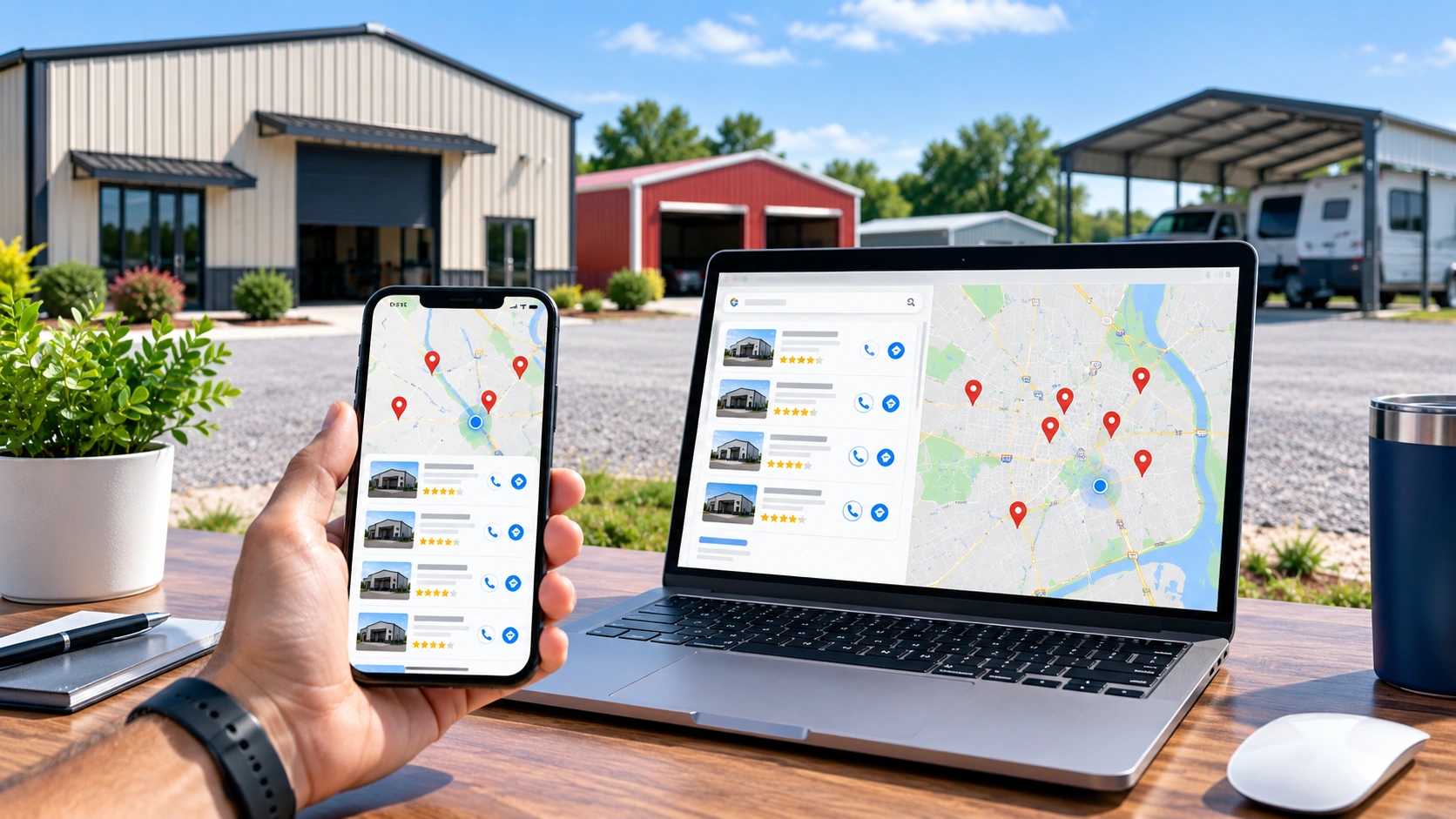
When someone searches for a metal building company, they often want a local business they can contact, visit, or get a quote from.
Searches such as “metal buildings near me,” “metal garage dealer near me,” “steel building company near me,” and “carport dealers near me” can trigger the Google Maps results that appear in the local search section.
For metal building dealers, appearing in these results can put your business in front of people who are already looking for the products and services you offer.
But getting into Google Maps is not simply about creating a Google Business Profile and waiting for customers to find you.
Google uses several local signals to determine which businesses appear prominently in local results. Your business information, location, relevance, reviews, website, citations, customer interactions, and overall local presence can all contribute to your visibility.
This guide explains how metal building dealers can improve their chances of ranking in Google Maps and generating more qualified local leads.
What Google Maps Ranking Means for Metal Building Dealers
Google Maps results are closely connected with local search.
For example, a customer in Dallas may search:
“metal building dealer near me”
Google may display a local map with several businesses.
A customer may also search:
“metal garages Dallas TX”
“steel buildings near me”
“carport dealer in Dallas”
“metal barn builder near me”
These searches can have strong commercial intent because the person is often looking for a company they can contact.
For a metal building dealer, appearing prominently in these local results can lead to:
- Phone calls
- Website visits
- Quote requests
- Direction requests
- Store or office visits
- Product inquiries
- Local brand awareness
The goal is not simply to get more map impressions.
The goal is to attract people who are looking for a metal building and are likely to become customers.
How Google Determines Local Rankings
Google generally considers three major local search factors:
Relevance
Google wants to show businesses that are relevant to what the customer searched for.
If your business primarily sells metal garages, but your Google Business Profile and website provide very little information about metal garages, Google may have less information to understand your relevance for that search.
Distance
Google considers the relationship between the searcher’s location and the business location.
A business located closer to the searcher may have an advantage for some searches.
You cannot completely control this factor, which is why having a genuine local presence matters.
Prominence
Prominence relates to how well-known and established a business appears to be.
Signals can include reviews, links, mentions, and other information about the business across the web.
You cannot control every factor Google uses, but you can build a stronger local presence through consistent and useful marketing.
1. Fully Complete Your Google Business Profile
Your Google Business Profile is one of the most important assets for local search.
Start by claiming and verifying your profile.
Then complete as much relevant information as possible.
Make sure you provide:
- Correct business name
- Accurate address
- Local phone number
- Website URL
- Business hours
- Business category
- Secondary categories where appropriate
- Business description
- Products or services
- Photos
- Videos
- Service areas where applicable
Do not leave important sections incomplete.
A partially completed profile can make it harder for potential customers to understand what your business offers.
2. Choose the Right Primary Business Category
Your primary Google Business Profile category tells Google what your business mainly does.
This decision should be based on your actual business operation.
For example, a dealer may need to evaluate categories related to:
- Metal construction
- Building materials
- Construction services
- Carport and storage solutions
- Steel building supply
The exact category options available in Google Business Profile can change, so select the most accurate current category that genuinely describes your business.
Do not choose a category simply because you believe it has more search volume.
Relevance matters.
3. Add Relevant Secondary Categories
Your primary category is not the only category that matters.
If your business genuinely provides multiple related services, use appropriate secondary categories when available.
For example, a dealer may sell:
- Metal garages
- Carports
- Metal barns
- RV covers
- Storage buildings
- Steel buildings
Do not add unrelated categories just to appear for additional searches.
Your categories should accurately represent what customers can actually purchase or receive from your business.
4. Write a Clear Business Description
Your business description should explain what you sell, where you serve customers, and what makes your business useful.
For example:
A metal building dealer serving customers throughout North Texas, providing custom metal garages, carports, RV covers, barns, workshops, and steel buildings in a range of sizes and configurations.
The description should sound natural.
Do not fill it with repeated keywords such as:
“metal buildings Dallas, metal garages Dallas, steel buildings Dallas, metal barns Dallas…”
Keyword stuffing does not make a business profile better.
Write for customers first.
5. Keep Your Business Name Consistent
Your Google Business Profile name should reflect your real-world business name.
Do not add keywords to your business name simply to try to rank higher.
For example, if your actual business name is:
“ABC Metal Buildings”
Do not change it to:
“ABC Metal Buildings | Metal Garages & Steel Buildings Dallas”
unless that is genuinely the business’s real-world name.
Keyword stuffing in the business name can create problems for your profile.
6. Use a Consistent NAP Across the Web
NAP stands for:
Name
Address
Phone number
Your business information should be consistent across important online platforms.
Check your:
- Website
- Google Business Profile
- Bing Places
- Apple Business Connect
- Industry directories
- Local directories
- Chamber listings
- Construction directories
For example, avoid having one website listing use:
ABC Metal Buildings LLC
and another listing use:
ABC Metal Building
and another use:
ABC Metal Buildings, Inc.
Small differences may not always cause a ranking problem, but maintaining accurate and consistent business information makes it easier for search engines and customers to understand your business.
7. Add Your Products and Services
Metal building dealers have many products that can be added to their Google Business Profile where the available profile features support them.
Consider adding relevant products or services such as:
- Metal garages
- Steel garages
- Metal barns
- Carports
- RV covers
- Metal sheds
- Workshops
- Commercial steel buildings
- Agricultural buildings
- Storage buildings
Use clear descriptions.
Instead of simply writing:
“Metal Garage”
Explain what the product is and what customers can use it for.
For example:
“Custom metal garages available in multiple sizes, roof styles, colors, door configurations, and other options.”
Do not add products that you do not actually sell.
8. Upload High-Quality Photos Regularly
Photos are extremely important for a metal building dealer because your products are visual.
Upload genuine photos of your:
- Completed metal garages
- Steel buildings
- Carports
- RV covers
- Metal barns
- Workshops
- Installation projects
- Team members
- Delivery vehicles
- Building materials
- Office or showroom
- Completed customer projects
Avoid relying entirely on stock images.
Real project photos give customers evidence of the work your company actually performs.
9. Add Project Videos
If your Google Business Profile supports video uploads, use them.
Short videos can show:
- Completed projects
- Installation work
- Building walkthroughs
- Interior layouts
- Before-and-after transformations
- Customer projects
- Product features
For example, a 30-second video showing a completed 30×40 metal garage can communicate far more than a generic company photo.
Video content can also be reused on your website and social media channels.
10. Get More Genuine Customer Reviews
Reviews are one of the most important parts of a local business presence.
After completing a project, ask satisfied customers to leave an honest review on your Google Business Profile.
Make the process easy.
You can send customers a direct review link after project completion.
Do not offer customers money, discounts, gifts, or other incentives in exchange for positive reviews.
You should also avoid asking customers to use specific keywords in their reviews.
Instead, ask for an honest review about their experience.
A natural review might mention:
- The type of building purchased
- Sales experience
- Installation
- Communication
- Project quality
- Overall experience
These details can also help future customers understand what it is like to work with your company.
11. Respond to Every Review
Getting reviews is only part of the process.
Respond to them.
Thank customers who leave positive reviews.
If someone raises a legitimate concern, respond professionally and explain how you are addressing it.
For example:
“Thank you for sharing your experience. We appreciate the opportunity to build your new 30×40 garage and are glad you are happy with the finished project.”
Keep responses natural.
Do not copy and paste the same response to every customer.
12. Create a Local SEO Website Structure
Your Google Business Profile should not operate independently from your website.
Your website should clearly explain:
- What you sell
- Where you operate
- Which areas you serve
- How customers can contact you
- Why customers should choose your company
Your main pages could include:
- Metal Buildings
- Metal Garages
- Metal Barns
- Carports
- RV Covers
- Commercial Steel Buildings
- About Us
- Contact
- Service Areas
Each important page should provide useful information rather than simply repeating city names.
13. Build Location Pages for Important Service Areas
If you genuinely serve multiple cities or regions, location pages can support your local SEO strategy.
For example:
- Metal Buildings in Dallas
- Metal Buildings in Fort Worth
- Metal Buildings in Arlington
- Metal Buildings in Houston
- Metal Buildings in Austin
For a Canadian dealer, examples could include:
- Steel Buildings in Calgary
- Metal Buildings in Edmonton
- Steel Buildings in Red Deer
However, do not create dozens of pages that contain almost identical content.
A good location page should include useful local information, such as:
- Products available
- Types of customers served
- Local project examples
- Service information
- Building considerations
- Relevant FAQs
- Contact information
- Real project photos
If you have completed projects in the area, include them.
Real local experience is much more useful than simply adding a city name to a template.
14. Create Local Project Case Studies
Completed projects are valuable for both marketing and local SEO.
Suppose you completed a 40×60 steel building for a customer in Fort Worth.
Create a case study that explains:
- Customer requirements
- Building size
- Building type
- Features
- Customizations
- Installation process
- Project challenges
- Final result
Include real photos.
You could also create a short video walkthrough.
A case study can then be linked from your relevant service page and location page.
15. Build Local Citations
A citation is an online mention of your business information.
Relevant citation sources can include:
- Local business directories
- Chamber of Commerce websites
- Industry directories
- Construction directories
- Building material directories
- Local community websites
- Business associations
The goal is not to submit your business to hundreds of low-quality directories.
Focus on reputable and relevant websites.
Quality matters more than the number of directory listings.
16. Get Local and Industry-Relevant Links
Links from relevant websites can support your overall local SEO presence.
For a metal building dealer, useful opportunities may include:
- Local news websites
- Chamber of Commerce websites
- Construction associations
- Agriculture organizations
- Local business organizations
- Supplier websites
- Community publications
- Industry publications
For example, if your company sponsors a local agricultural event, there may be an opportunity for the event organizer to mention your company on its website.
The link should come from a legitimate relationship or useful contribution.
Do not buy hundreds of low-quality links just to increase the number of backlinks.
17. Publish Local Metal Building Content
Create content around the questions customers in your market actually ask.
Examples include:
- How Much Does a Metal Garage Cost in Texas?
- What Size Metal Garage Do I Need for Two Vehicles?
- Metal Building Permit Requirements in Texas
- Best Metal Building Options for Texas Ranches
- Metal Garage Ideas for North Texas Homeowners
- What Size RV Cover Do I Need?
- Metal Barn Options for Oklahoma Properties
The exact topic should depend on your market and the products you sell.
Local content works best when it provides useful information rather than simply inserting a city name into a generic article.
18. Use Local Keywords Naturally
Your website should use the terms customers actually search for, but keywords should fit naturally into the content.
Examples may include:
- metal buildings near me
- metal building dealer
- metal garage dealer
- steel building dealer
- metal garages
- metal barns
- carport dealer
- RV cover dealer
- commercial steel buildings
Add location modifiers where relevant:
- metal buildings Dallas TX
- metal garages Houston TX
- steel buildings Calgary AB
- metal barns Oklahoma City
Do not repeat the same keyword in every paragraph.
Use variations that make sense for the page.
19. Add Local Business Schema to Your Website
Structured data can help search engines understand information about your business.
For a local metal building dealer, relevant structured data may include information such as:
- Business name
- Address
- Phone number
- Website
- Business hours
- Geographic information
- Service areas
- Social profiles
Use the appropriate schema type and make sure the information matches what is visible on your website.
Do not add false information simply because a schema field exists.
20. Improve Your Website’s Local Conversion Rate
Ranking in Google Maps is only one part of local lead generation.
Imagine a customer finds your company in Google Maps, visits your website, and cannot quickly figure out how to request a quote.
That is a missed opportunity.
Your website should make it easy for visitors to:
- Call your business
- Request a quote
- View products
- See completed projects
- Find service areas
- Ask questions
- Use a building estimator if available
Your phone number and quote CTA should be easy to find on mobile devices.
21. Make Your Website Mobile-Friendly
Many local searches happen on mobile devices.
A customer searching for “metal buildings near me” may immediately click a map listing and visit your website from their phone.
Your website should therefore work well on smaller screens.
Check:
- Page loading speed
- Font size
- Button size
- Navigation
- Quote forms
- Phone links
- Image sizes
- Contact information
A customer should not have to zoom in or struggle with a complicated form to request information.
22. Use Google Search Console and Google Analytics
Google Search Console can help you understand how your website performs in Google Search.
Google Analytics can help you understand what visitors do after arriving on your website.
Look for:
- Local search queries
- Organic traffic
- Landing pages
- Phone clicks
- Form submissions
- User engagement
- Conversion paths
If you notice that people are landing on a particular metal garage page and frequently requesting quotes, that page deserves continued attention.
23. Track Calls and Quote Requests From Local Search
For a metal building dealer, phone calls can be more valuable than clicks.
Someone who calls and says:
“I need a 30×40 metal garage on my property”
is a much stronger lead than someone who simply visits your homepage.
Use call tracking where appropriate to understand which marketing channels generate calls.
Track:
- Google Business Profile interactions
- Organic search
- Google Ads
- Website forms
- Phone calls
- Quote requests
This allows you to judge your local SEO based on business results rather than rankings alone.
24. Keep Your Google Business Profile Active
Your Google Business Profile should accurately reflect your current business.
Update information when something changes.
Add new photos when you complete projects.
Keep business hours accurate.
Add relevant products and services.
Respond to reviews.
Share useful updates when appropriate.
However, do not assume that posting every day will automatically make you rank higher in Google Maps.
Profile activity is useful for customers, but local ranking depends on much more than how frequently you publish posts.
25. Avoid Fake Locations
This is one of the biggest mistakes a multi-location metal building company can make.
Do not create fake Google Business Profiles at:
- Employees’ homes
- Virtual offices
- Mailboxes
- Coworking spaces without a genuine eligible presence
- Random addresses in cities you want to target
If you do not have a legitimate business presence at a location, do not create a profile there simply to rank in that market.
Instead, use your website’s service-area strategy and other legitimate local marketing methods.
26. Do Not Stuff Keywords Into Your Google Business Profile
Adding the same keyword repeatedly will not create a strong local presence.
For example, avoid descriptions such as:
“Best metal building dealer for metal buildings, metal garages, steel buildings, metal barns, carports and steel garages.”
Write naturally.
Google needs to understand your business, but customers also need to understand what you actually offer.
27. Build a Strong Local Review Strategy
Do not wait until you need more reviews.
Create a repeatable process.
After a project is successfully completed:
- Thank the customer.
- Ask if they are satisfied with the completed project.
- Send your Google review link.
- Ask them to share their honest experience.
- Respond when they leave a review.
You can also identify important points in the customer journey where asking for feedback makes sense.
For example, after installation is completed and the customer has had an opportunity to inspect the building.
28. Use Real Customer Projects Everywhere
A completed project can support several parts of your marketing.
One project can become:
- Google Business Profile photos
- A Google Business Profile video
- Website case study
- Blog article
- Social media post
- YouTube video
- Location page content
- Email marketing content
- Sales presentation material
This is particularly useful for metal building companies because every completed structure is visual proof of your work.
29. Build a Local SEO Content Cluster
Instead of publishing unrelated blog posts, organize your content around your products and service areas.
For example, your metal garage content cluster could include:
Main page
Metal Garages
Supporting content
- How Much Does a Metal Garage Cost?
- What Size Metal Garage Do I Need?
- Metal Garage vs Pole Barn
- How to Prepare Your Property for a Metal Garage
- Can a Metal Garage Be Insulated?
- Best Metal Garage Sizes for Two Vehicles
Then connect these articles to your main metal garage page.
You can create similar clusters for:
- Metal barns
- Carports
- RV covers
- Commercial steel buildings
- Agricultural buildings
This gives your website more depth around the products you actually sell.
30. Focus on Qualified Local Leads
The ultimate goal of Google Maps SEO is not to become number one for every possible keyword.
Your goal is to attract customers who are actually interested in your products and service area.
For example, ranking for:
“metal building dealer near me”
can be valuable if the searcher is within your service area and looking for a dealer.
But ranking for a broad informational query that generates visitors who cannot purchase from your company may not produce much business.
Focus your local SEO strategy around:
- Relevant products
- Real service areas
- Commercial intent
- Customer questions
- Local projects
- Qualified leads
A Google Maps SEO Checklist for Metal Building Dealers
Use this checklist to review your local SEO setup.
Google Business Profile
- Claim and verify your profile
- Use the correct business name
- Select the most relevant primary category
- Add relevant secondary categories
- Complete your business information
- Add accurate business hours
- Add products and services
- Upload real project photos
- Add videos where appropriate
- Respond to customer reviews
Website
- Create dedicated product pages
- Create useful service-area pages
- Display your business information clearly
- Add local business structured data where appropriate
- Make the website mobile-friendly
- Add clear quote CTAs
- Make phone numbers clickable
- Publish useful local content
- Add real project case studies
Reviews
- Ask satisfied customers for honest reviews
- Make the review process simple
- Respond to reviews
- Do not buy reviews
- Do not create fake reviews
- Do not offer incentives for positive reviews
Local Authority
- Build relevant local citations
- Maintain consistent business information
- Get legitimate local links
- Participate in relevant local organizations
- Build relationships with industry publications
- Publish genuine local project content
How Long Does It Take to Rank in Google Maps?
There is no fixed timeframe for Google Maps rankings.
Local search performance depends on factors such as:
- Competition
- Location
- Business history
- Reviews
- Website quality
- Local authority
- Business relevance
- Searcher’s location
- Existing online presence
A metal building dealer in a smaller market may face very different competition from a dealer operating in a major city such as Dallas, Houston, Toronto, or Calgary.
Instead of expecting a specific ranking within a certain number of weeks, focus on improving the factors your business can actually control.
Final Thoughts
Ranking in Google Maps requires more than creating a Google Business Profile.
For metal building dealers, a strong local SEO strategy should connect your Google Business Profile, website, reviews, local content, citations, links, project photos, and lead-generation process.
Start with the basics.
Make sure your business information is accurate.
Choose the right categories.
Add your products and services.
Publish real project photos and videos.
Ask satisfied customers for genuine reviews.
Build useful location and product pages.
Create content around real customer questions.
Build legitimate local and industry relationships.
Most importantly, do not try to manipulate Google Maps with fake locations, keyword-stuffed business names, or fake reviews.
Build a genuine local presence that helps customers understand what you sell, where you operate, and why they should contact your company.
For a metal building dealer in the United States or Canada, that approach can help turn local search visibility into something much more valuable than map impressions: qualified calls, quote requests, and new customers.